Metabolism

Metabolism

Join our mailing list. We never spam.

Metabolism

Metabolism

Join our mailing list. We never spam.

Metabolism

Metabolism

Join our mailing list. We never spam.

All articles tagged

"

Metabolism

"

Health

Feb 2, 2026

What Is Metabolic Age and How Does It Affect Your Health?

Your metabolic age is an important indicator of how well your body is functioning compared to your actual age. While your chronological age marks the passage of time, your metabolic age reflects how efficiently your metabolism is functioning.

It’s influenced by factors like your diet, exercise, and overall health. In this article, we’ll explain what metabolic age is, how it’s calculated, and share simple tips to help you improve it for better health.

What is Metabolic Age?

Infographic of male metabolic health data displaying 1800 BMR and 35-year-old metabolic age with a needle gauge indicating average health status.

Metabolic age is a comparison between your basal metabolic rate (BMR) and the average BMR of people in your chronological age group. In simpler terms, it tells you whether your metabolism is performing like that of someone younger, older, or right around your actual age.

Your basal metabolic rate represents the number of calories your body needs to perform basic life-sustaining functions while at rest (e.g., breathing, circulating blood, producing cells, and maintaining body temperature). It's essentially your body's baseline energy expenditure, accounting for roughly 60-75% of your total daily calorie burn.

When health professionals or body composition scales calculate your metabolic age, they're measuring your BMR and comparing it against population data. If your BMR is higher than average for your age group, you'll have a lower metabolic age. If it's lower than average, your metabolic age will be higher than your chronological age.

Here's a practical example: 

Let's say you're 45 years old, but your BMR matches the average BMR of a typical 35-year-old. Your metabolic age would be 35. Conversely, if your BMR matches that of a 55-year-old, your metabolic age would reflect that higher number.

The concept emerged from research into body composition and metabolic health, particularly as scientists recognized that chronological age alone doesn't tell the full story of someone's health status. Two people born on the same day can have vastly different metabolic profiles based on their lifestyle choices, genetics, and overall health.

It's worth noting that metabolic age isn't a standardized medical diagnostic tool in the way blood pressure or cholesterol levels are. Different devices and calculations may produce slightly different results because there's no universal formula or database. But, the underlying principle remains consistent: comparing your metabolism to population averages gives you a snapshot of your metabolic health relative to your peers.

What Metabolic Age Really Means for Your Health?

Your metabolic age can be a helpful reference point for understanding metabolic health trends, but it should be interpreted alongside other health markers.

  • Research suggests metabolic health is associated with longevity and lower risk of chronic conditions.

  • When your metabolic age is lower than your chronological age, it generally suggests several positive health markers. You likely have more lean muscle mass and less body fat, particularly visceral fat. Higher muscle mass increases your BMR because muscle tissue is metabolically active, meaning it burns calories even when you're sitting on the couch.

  • A younger metabolic age also typically indicates better insulin sensitivity, which means your body efficiently processes glucose and maintains stable blood sugar levels. This is often associated with better blood sugar control and cardiometabolic markers. Studies have shown that people with better metabolic health tend to have lower inflammation markers, healthier cholesterol profiles, and better blood pressure readings.

  • On the flip side, if your metabolic age is higher than your chronological age, it may reflect patterns such as higher body fat, lower muscle mass, or both. Research has linked a higher metabolic age to greater cardiometabolic risk, including higher risk of cardiovascular disease and future cardiovascular events. This is not a diagnosis, but it can be a useful signal to review lifestyle factors like activity, nutrition, sleep, and stress.

Metabolic Age vs. Chronological Age: What's the Difference?

Chronological age is the number of years since you were born. Metabolic age, by contrast, is dynamic and changeable.

You might be chronologically 50 but metabolically 40 if you've maintained excellent fitness, preserved muscle mass, and kept your body fat in check. Alternatively, a sedentary 30-year-old with poor dietary habits might have the metabolism of someone in their 40s or 50s.

The gap between these two ages reveals something critical: biological aging doesn't proceed at the same rate for everyone.  

One significant advantage of focusing on metabolic age rather than chronological age is that it shifts attention to factors you can control. You can't change when you were born, but you absolutely can influence your metabolic health through daily choices. This perspective empowers you to take ownership of your health trajectory.

Aspect

Chronological Age

Metabolic Age

Definition

The number of years since you were born.

A measure of how efficiently your body is functioning based on metabolism.

Changeability

Fixed and unchangeable.

Dynamic and can change based on lifestyle, fitness, and health choices.

Influencing Factors

Cannot be influenced.

Can be influenced by diet, exercise, muscle mass, and body fat.

How is Metabolic Age Calculated?

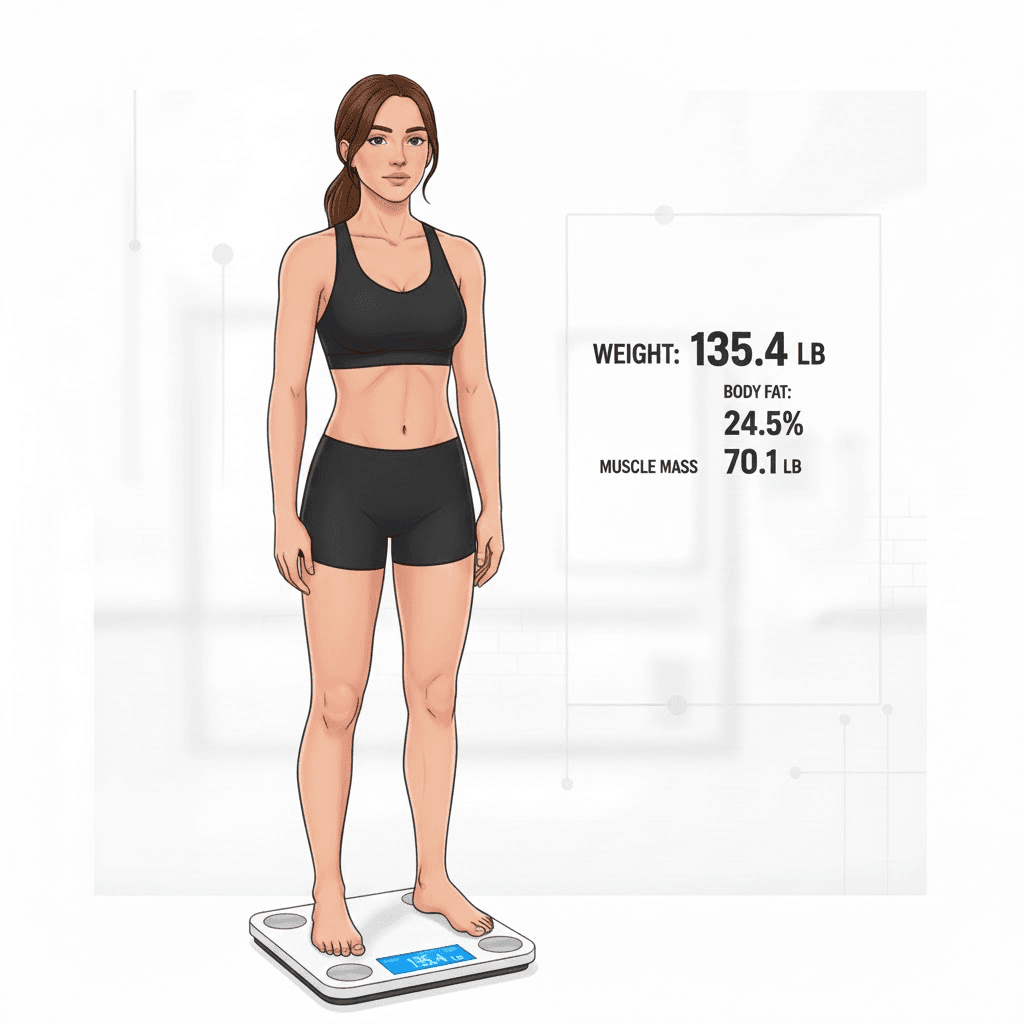
Infographic showing body composition analysis for a woman, including weight tracking, body fat percentage, and muscle mass measurements on a smart scale.

The calculation of metabolic age involves several steps and requires specific body composition data. While the exact algorithms vary between devices and calculation methods, the fundamental process follows a similar pattern.

Step 1: Determining Basal Metabolic Rate (BMR)

First, your basal metabolic rate (BMR) needs to be determined. BMR is the number of calories your body needs at rest to perform basic functions like breathing and maintaining body temperature.

There are several ways to measure or estimate BMR. The gold standard is indirect calorimetry, which measures oxygen consumption and carbon dioxide production to precisely calculate energy expenditure. However, this method requires specialized equipment and is typically only available in research or clinical settings.

Step 2: Using Bioelectrical Impedance Analysis (BIA)

More commonly, bioelectrical impedance analysis (BIA) devices estimate your body composition by sending a weak electrical current through your body. Since muscle and fat conduct electricity differently, the device can estimate your percentages of muscle mass, body fat, bone density, and water content. Many modern smart scales and body composition analyzers, such as InBody devices, use this technology to provide BIA-based estimates.

Step 3: Calculating BMR Using Mathematical Formulas

Once your body composition is known, mathematical formulas calculate your BMR. Several equations exist for this purpose, including the Harris-Benedict equation, the Mifflin-St Jeor equation, and the Katch-McArdle formula. These formulas consider variables like weight, height, age, sex, and lean body mass.

For example, the revised Harris-Benedict equation calculates BMR as:

  • For men:
    BMR = 88.362 + (13.397 × weight in kg) + (4.799 × height in cm) - (5.677 × age in years)

  • For women:
    BMR = 447.593 + (9.247 × weight in kg) + (3.098 × height in cm) - (4.330 × age in years)

The Katch-McArdle formula, which incorporates lean body mass, often provides more accurate results:

  • BMR = 370 + (21.6 × lean body mass in kg)

Step 4: Comparing BMR with Age Group Databases

Once your BMR is calculated, it’s compared against a database of average BMR values for different age groups. This database typically includes BMR data collected from thousands or millions of people across various ages. The comparison reveals where your metabolism falls on the spectrum.

If your BMR equals the average BMR for 35-year-olds, your metabolic age is 35, regardless of whether you’re actually 25, 35, or 45. The device or software essentially asks: “What age group does this person’s metabolism most closely resemble?”

It’s important to understand that different manufacturers may use different reference databases and proprietary algorithms.  

Also, some limitations exist with metabolic age calculations. They don't account for factors like hormonal variations, certain medical conditions, medications, or genetic variations that affect metabolism. Two people with identical body compositions might still have different actual metabolic rates due to thyroid function, mitochondrial efficiency, or other physiological differences that the calculation doesn't capture.

How to Improve Your Metabolic Age?

Fitness and wellness lifestyle graphic depicting strength training, healthy meal preparation, and the importance of sleep for recovery.

If your metabolic age is higher than you'd like, the good news is that you have significant power to improve it. The strategies that lower metabolic age are the same ones that improve overall health:

Build and Preserve Muscle Mass

Increasing your lean muscle mass is perhaps the most effective way to lower your metabolic age. Muscle tissue burns significantly more calories at rest than fat tissue does. Estimates of tissue-specific resting metabolic rates suggest skeletal muscle uses about 13 kcal per kg per day compared with about 4.5 kcal per kg per day for adipose tissue, which is roughly 6 versus 2 kcal per pound per day. Individual metabolic rate still depends on many factors, including total lean mass and organ activity.

Resistance training can play a major role in preserving muscle and supporting metabolic health. Aim for at least two to three strength training sessions per week, targeting all major muscle groups.  

As you age, you naturally lose muscle mass in a process called sarcopenia, which can start as early as your 30s and accelerate after 50. Counteracting this requires consistent effort, but the metabolic payoff is substantial. Progressive overload, gradually increasing the weight, reps, or difficulty of your exercises, ensures continued muscle growth.

Optimize Your Nutrition

What you eat profoundly affects your body composition and metabolic health. Prioritize protein intake, as protein supports muscle maintenance and growth. The Recommended Dietary Allowance for protein is 0.8 grams per kilogram of body weight, which is about 0.36 grams per pound. Some people may benefit from higher intakes depending on activity level and goals, but individual needs vary.

Avoid excessive calorie restriction, which can actually slow your metabolism. Severe dieting triggers adaptive thermogenesis, where your body becomes more efficient (burns fewer calories) to conserve energy. Instead, if weight loss is a goal, focus on moderate and sustainable changes in energy intake that you can maintain over time.

Focus on whole, minimally processed foods that provide nutrients without excess calories from added sugars and unhealthy fats. Adequate protein, healthy fats, and complex carbohydrates provide the building blocks your body needs for optimal metabolic function.

Don't skip meals or go extremely low-calorie for extended periods. Consistent, adequate nutrition supports metabolic health better than dramatic restriction followed by overeating.

Incorporate Cardiovascular Exercise

While cardio doesn't build muscle like resistance training does, it supports overall metabolic health, improves insulin sensitivity, and helps with fat loss. High-intensity interval training (HIIT) appears particularly effective for metabolic benefits, alternating short bursts of intense effort with recovery periods.

Aim for at least 150 minutes of moderate-intensity aerobic activity or 75 minutes of vigorous activity per week, as recommended by the CDC. This supports cardiovascular health, helps maintain a healthy weight, and improves your body's ability to process nutrients efficiently.

Prioritize Quality Sleep

Sleep deprivation wreaks havoc on metabolism. Poor sleep disrupts hormones like leptin and ghrelin that regulate hunger, increases cortisol (which promotes fat storage), and reduces insulin sensitivity. Chronic sleep debt is associated with weight gain, increased body fat, and muscle loss.

Aim for 7-9 hours of quality sleep per night. Establish consistent sleep and wake times, create a dark and cool sleeping environment, and limit screen time before bed. Think of sleep as a non-negotiable pillar of metabolic health, not a luxury.

Manage Stress Effectively

Chronic stress elevates cortisol, which promotes abdominal fat accumulation and can break down muscle tissue. High cortisol also impairs insulin sensitivity and can increase appetite and cravings for high-calorie foods.

Incorporate stress management techniques that work for you, meditation, yoga, deep breathing exercises, time in nature, or engaging hobbies. The specific method matters less than finding sustainable practices that genuinely reduce your stress levels.

Stay Hydrated and Limit Alcohol

Proper hydration supports all metabolic processes. Even mild dehydration can reduce metabolic rate slightly. Water also helps with appetite regulation and supports exercise performance.

Alcohol, meanwhile, can interfere with muscle protein synthesis, adds empty calories, and can disrupt sleep and recovery. Moderation or elimination of alcohol often leads to improvements in body composition and metabolic markers.

Be Patient and Consistent

Improving metabolic age doesn't happen overnight. Significant changes in body composition typically take weeks to months of consistent effort. Focus on building sustainable habits rather than seeking quick fixes. Small, consistent improvements compound over time into dramatic transformations.

Track your progress not just through metabolic age measurements but also through how you feel, your energy levels, exercise performance, and how your clothes fit. These subjective markers often improve before the numbers change significantly.

Key Takeaways

  • Metabolic age compares your basal metabolic rate (BMR) to the average BMR of people in your chronological age group, showing whether your metabolism functions like someone younger or older.

  • Understanding what metabolic age means can help you interpret trends related to body composition and metabolic health.

  • Building and preserving muscle mass through resistance training is the most effective way to lower your metabolic age, as muscle burns significantly more calories at rest than fat.

  • Your metabolic age is dynamic and responsive to lifestyle changes like nutrition, exercise, sleep quality, and stress management, unlike your fixed chronological age.

  • A metabolic age higher than your actual age serves as a warning sign for potential health issues, while a lower metabolic age typically indicates favorable body composition and better metabolic health.

  • Consistency in healthy habits matters more than quick fixes when improving metabolic age, as significant changes in body composition and metabolic function take weeks to months of sustained effort.

Frequently Asked Questions

What does metabolic age mean?

Metabolic age compares your basal metabolic rate (BMR) to the average BMR of people in your chronological age group. It indicates whether your metabolism functions like someone younger, older, or the same as your actual age based on body composition and energy expenditure.

How can I lower my metabolic age?

You can lower your metabolic age by building muscle through resistance training, eating adequate protein, incorporating cardio exercise, getting 7-9 hours of quality sleep, managing stress effectively, and maintaining a healthy body composition with less body fat and more lean muscle mass.

What is the difference between metabolic age and chronological age?

Chronological age is simply the number of years since you were born, which advances steadily and cannot be changed. Metabolic age is a functional measure of how efficiently your body burns energy, which can be improved or worsened based on lifestyle choices and health habits.

Is metabolic age an accurate indicator of health?

Metabolic age provides useful insight into metabolic health and body composition, but it's not a standardized medical diagnostic tool. Different devices may give varying results, and it should be considered alongside other health markers like blood pressure, cholesterol, and blood sugar levels.

Can you reverse your metabolic age?

Yes, metabolic age is changeable and responsive to lifestyle interventions. By increasing lean muscle mass, improving nutrition, exercising regularly, and adopting healthy sleep and stress management habits, you can effectively lower your metabolic age over time with consistent effort.

What causes a high metabolic age?

A high metabolic age typically results from excess body fat, insufficient muscle mass, sedentary lifestyle, poor nutrition, inadequate sleep, and chronic stress. These factors reduce your basal metabolic rate, making your metabolism function like someone older than your actual age.


Overhead view of healthy breakfast spread with waffles, oatmeal bowls, and berries

Health

May 29, 2019

Is It Possible to Boost Your Metabolism? The Truth About Metabolic Flexibility

Eat carbs before you work out. It will improve your performance. No, don’t – eat fats like peanut butter or avocados. No, actually, don’t eat at all and your body will burn more calories. Refuel with carbs. No, recover with protein to build muscle.

Is your head spinning yet?

You’re not alone if you ever feel like every health article you see contradicts the one you saw the day before.

If you stay up-to-date on health news and research, the very word “metabolism” may seem antiquated and overused. But it’s everywhere because it really IS that important. Your metabolism is the process (or series of processes, rather) that dictate how your body functions.

Even though the word appears ubiquitously, most of us misunderstand what metabolism really is and what it does. Yes, your metabolism determines how much and how often you need to eat, but most people overlook the fact that metabolic reactions take place in every single cell in your body.

“Metabolism” refers to the series of chemical processes in each cell that turn your food into energy to keep you alive. And because your metabolism is so complex, it’s able to use different sorts of fuel to your body’s advantage.

This is where the perpetual carbs-versus-fats debate comes into play. Everyone’s quick to tell you about their success with the Keto diet or how more balanced macros improved their performance in the gym.

In reality, there’s no perfect diet. Everyone’s preferred macronutrient ratio and calorie intake depend on their unique resting metabolic rate, activity level, food sensitivities, and more. But there is one thing everyone can count on: Your body will – or should – use what you give it.

What Is Metabolic Flexibility?

body composition a woman eating muffin

If you eat a lot of fats, fat will be your body’s primary source of fuel. If you eat a lot of carbohydrates, glucose will be your body’s primary source of fuel. If you eat more protein than anything else – you guessed it – your body will burn more protein for energy.

Metabolic flexibility is your body’s ability to adapt to metabolic demands. When things change – such as changing what time you eat breakfast or what you eat for breakfast – your body is forced to change the way it metabolizes your food.

When you eat, your food is either burned for energy or stored if what you ate was in excess of your energy needs. Any excess carbohydrates are stored as glycogen(which serves as quick energy reserves) or fat tissue if glycogen stores are full. Any extra fat is also put away for later use, as fat tissue.

How flexible your metabolism refers to how efficiently your body can switch between using carbs or fats for fuel – or, more importantly – how efficiently it can use what is already available.

Someone with great metabolic flexibility can burn carbs when they eat them. They can also burn fat when they eat it, or when they don’t eat at all. People with flexible metabolisms can “flex” between carbohydrate metabolism and fat oxidation relatively easily.

For example, a person with great metabolic flexibility does cardio in the morning on an empty stomach. Because their metabolism is highly flexible, their body powers through the workout on fat tissue that already exists. The same person, however, could eat oatmeal and a banana an hour or two before their workout and instead use those carbs as fuel (instead of storing them for later use).

Why Do We Need Metabolic Flexibility?

Why Everyone Needs Protein. Yes, Even You steak salad and fish on table

A flexible metabolism gives your body more leeway when determining what fuel source to use. Take the example of the person doing fasted cardio in the previous section. If that person was metabolically inflexible and exercised on an empty stomach, he or she would first burn through the glycogen (stored carbohydrates) in their body – leaving the fat untouched.

This is why it’s so hard for many people to burn fat: They are metabolically inflexible.

If you’re very metabolically flexible, eating calorie-dense, sugar-laden, or very fatty foods from time to time won’t always be an issue for your body. Your body can convert those calories into energy without much negative aftermath.  

Those who are metabolically flexible carry more mitochondria in their muscles, which allows them to produce energy more efficiently. Having too few mitochondria, or having dysfunctional mitochondria, limits the amount of energy a person can produce. It makes switching between fuels difficult, which makes utilizing any stored body fat between meals almost impossible. This is why metabolically inflexible people tend to snack often.

Side Effects of Metabolic Inflexibility

So we know now that the benefits of metabolic flexibility are vast. But what’s the big deal if we aren’t so good at flexing our metabolism muscle?

In simple terms, metabolically inflexible people generally feel pretty poor.

Side effects of metabolic inflexibility include fatigue, weight gain, brain fog, poor sleep, low mood or depression, poor cognitive function (poor ability to focus), and shortness of breath. If you find it hard to finish tasks at hand, taking frequent coffee breaks for caffeine-induced energy, getting frustrated easily, or having trouble sleeping, you may have an inflexible metabolism.

Additionally, metabolically inflexible people tend to be excessively hungry or have an unusually strong appetite. This is because their bodies aren’t good at burning what’s already there.

How to Train Your Metabolism to Be More Flexible

A ketogenic diet with fresh vegetables

The key to understanding metabolic flexibility is understanding how insulin regulates our energy. A healthy person with normal insulin action can effectively switch between fats and carbs as fuel. An insulin-resistant person cannot do this as effectively.

Insulin is the hormone that regulates your blood sugar by taking glucose into your bloodstream. There are two primary states of being as it relates to a person’s metabolism: fed and fasting.

During fed conditions (e.g., having just eaten), your insulin levels will be high due to incoming food. During fasting conditions, someone who is very metabolically flexible will easily be able to tap into stored body fat. The workings of insulin are vast, and you can learn more here, but these points are essential to understanding metabolic flexibility:

  • All food you eat, regardless of macronutrient composition, sparks the release of insulin.

  • Insulin is a factor in deciding which fuel source your body uses.

  • When insulin levels are low, your body primarily burns fat.

  • When insulin levels are high, your body primarily burns carbs and stores fat.

One of the best – and easiest – ways to improve your metabolic flexibility is to exercise. If you’re generally sedentary, adding exercise to your days is a surefire way to kick your body into a fat-burning mode it’s never experienced before. If you already exercise regularly, add more variety to your workouts.

Varying the type of training you do (strength training, intervals, and some sort of aerobic or endurance activity) might just give your body the nudge it needs to tap into your fat reserves. Different types of exercise use different mixes of fuel and eventually may train your body to use different fuel sources during day-to-day activities.

Fasted cardio is one type of exercise intended to tap heavily into your body’s fat reserves. Doing high-intensity cardiovascular exercise with little to no glycogen stored can train your metabolism to be more flexible.

Another way to improve your metabolic flexibility is intermittent fasting (IF). Remember the person who used body fat as fuel during their morning fasted cardio? That worked because his or her body was trained to use the available energy in the absence of food.

Metabolically inflexible people would just feel atrocious in the same scenario because their bodies don’t know how to function without incoming energy (food). If you can’t make it more than two-to-three hours without food, you’re impairing your body’s ability to utilize your body fat. Work slowly to increase your spacing between meals.

Timing your nutrient intake can help your body use fat more efficiently, and the longer the fasting period, the more your body has to tap into its fat reserves, which may be one way to combat obesity.

You should also test out different macronutrient ratios. The fewer carbohydrates you consume, the more your body will have to rely on fat sources for fuel. This is the premise behind the ketogenic diet. Try cutting out added sugars and overly processed grains first. Then you can try reducing your carb intake even further by cutting out starches like potatoes. If keto’s not for you, try out the paleo diet, which is also low in carbs and higher in fat and protein.

While it’s encouraged to consume fats, avoid trans fats and too many saturated fats. Try to get your fats from nutrient-dense sources like olive and coconut oils, avocados, nuts, seeds, and fatty fish.

Also, consume more antioxidant-rich foods: Antioxidant consumption has been linked to a reduced risk of metabolic syndrome, as well as an increase in insulin sensitivity.

A Flexible Metabolism Means More Energy, a Better Body Composition, and Improved Health

a group of people giving thumbs up

To sum up, metabolic flexibility is the ability to switch from one fuel source to the next: from fats to carbs and vice versa. Metabolic inflexibility is the opposite: the inability (or limited ability) to switch from one fuel source to the other. For those concerned with body composition, inflexibility can be a real downer because it’s impossible to lose body fat if your body can’t burn it.

A flexible metabolism is efficient at using excess adipose tissue (fat) for energy, which over time decreases the ratio of fat mass to lean mass, resulting in a better body composition and decreased heatlh risk.

It’s hypothesized that metabolic inflexibility also plays a role in various diseases processes such as metabolic syndrome; so along with better body composition, being metabolically flexible can improve overall health and wellness by boosting insulin sensitivity, reducing the risk of disease, and training your body to adapt to metabolic demands.

Though this may all seem too complex to try, it’s not really that complicated: Think about your ancestors, what they ate, how much, and how often. It’s no secret that whole-food nutrition (fruits, vegetables, lean protein, nuts, and seeds) and exercise are the keys to a lean, healthy body.

Training your body to endure longer periods of time without food is also key to mastering fat-burning mode. Our hunter-gatherer predecessors didn’t have access to the abundance of food we do. They were forced to go long periods of time without eating, and thus their metabolisms kept them alive by burning what fat they had stored on their bodies.

If you’re interested in improving your body composition or general wellness, it’s worth experimenting with exercise, fasting, and macronutrients to train your metabolism to be flexible.

**

Amanda Capritto is a certified personal trainer and health coach who writes about nutrition, fitness and healthcare. A journalism alumna of Louisiana State University, Amanda spends her free time adventuring outdoors, hitting the gym, and encouraging people to live balanced, healthy lifestyles.

Cup of tea beside notepad with BMR and basal metabolic rate notes

Fitness

Oct 6, 2018

Your Metabolism and Your Body Composition

Editor’s Note: This post was updated on October 5, 2018, for accuracy and comprehensiveness. It was originally published on February 10, 2016

You probably don’t think about your body composition when you’re thinking about your metabolism. But you should.

You probably think about it in terms of speed: “My metabolism is fast” or “my metabolism is slowing down.”  If that sounds like you, you’re not alone: simply googling the word “metabolism” yields 4 articles in the top 10 all based around boosting/increasing your metabolism for weight loss.

People are naturally afraid of their metabolism slowing and the weight gain they know comes with it. To some extent, those worries are well-founded.

Metabolism is linked with weight gain and loss because of its a biological process involved with energy and calories.  

The Mayo Clinic defines metabolism as:

…the process by which your body converts what you eat and drink into energy. During this complex biochemical process, calories in food and beverages are combined with oxygen to release the energy your body needs to function.

Notice how it doesn’t mention anything about the speed you process your food. That would be digestion.

In medical terminology, metabolism is known as your Basal Metabolic Rate (BMR), which is the minimum number of calories your body needs to perform basic bodily functions. BMR is usually expressed in terms of calories.  Your Basal Metabolic Rate also has another interesting quality: the more Lean Body Mass (which includes muscle, water, and minerals) you have, the greater your BMR will be.

When we talk about metabolism, we should always start the conversation with how many calories your body needs. But because your BMR and Lean Body Mass are linked, that means any conversation about metabolism becomes a conversation about your body composition.

Your Body Composition Is Linked To Your Metabolism

Why is it that some people seem to be able to eat whatever they want and never experience any weight gain, while other people – even skinny people – feel like whenever they have one bite of dessert it instantly goes to their waistline?

The reason is that metabolism can vary in size.

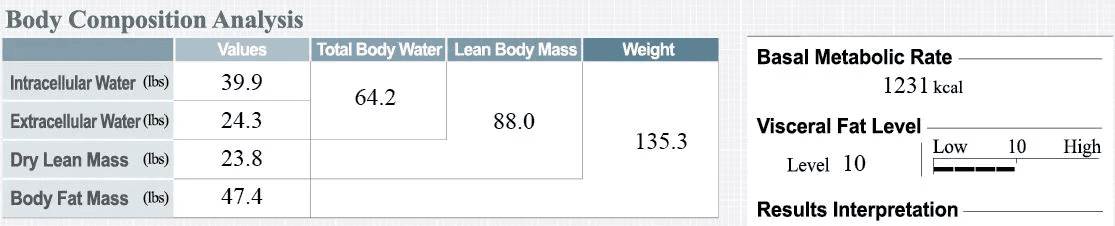
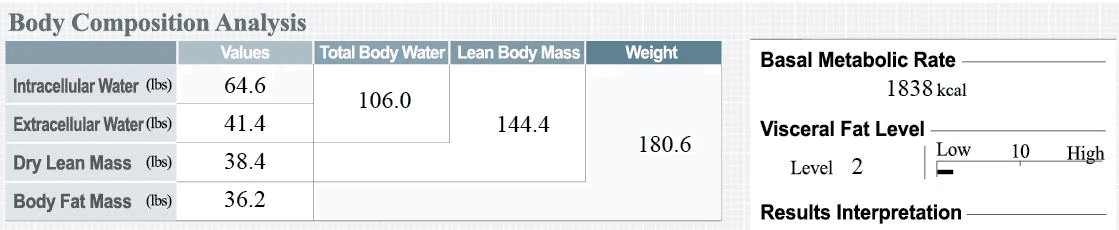
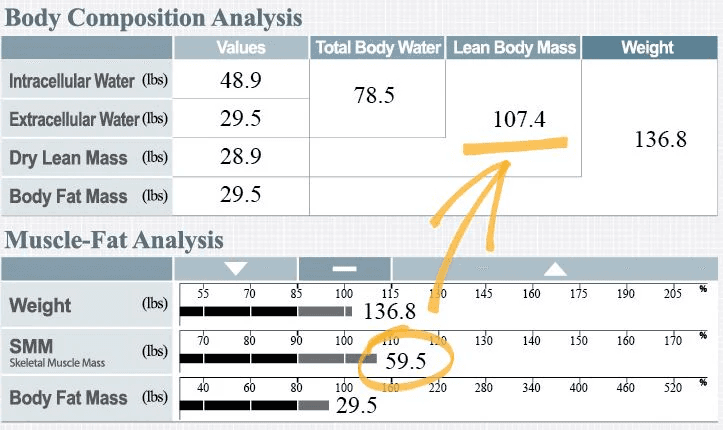
Take a look at these two body composition profiles, and see if you can spot the difference.

Beyond the obvious differences in weight, the Person A has a much smaller Basal Metabolic Rate than the second.  This means Person B needs more calories than Person A in order to provide their body with the necessary energy to function without losing weight.  Because the BMR is bigger, the metabolism is “bigger.”

Greater than height and gender, the most important factor playing into BMR is the amount Lean Body Mass each person has.  That’s because, as research in the American Journal of Clinical Nutrition states, the more Lean Body Mass you have, the greater your Basal Metabolic Rate will be. That is why strength training for muscle gain, which in turn will increase your lean body mass, is recommended as a way to increase your metabolism.

This is why people who are big or above average in weight can eat more than people who are smaller.  Their body literally requires them to eat more to maintain their weight, and specifically – their Lean Body Mass.

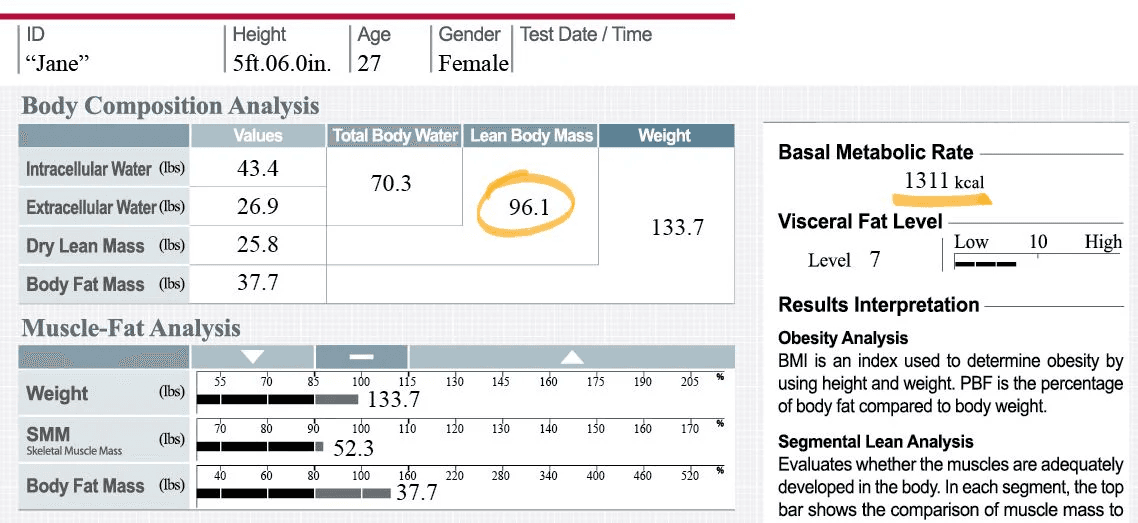
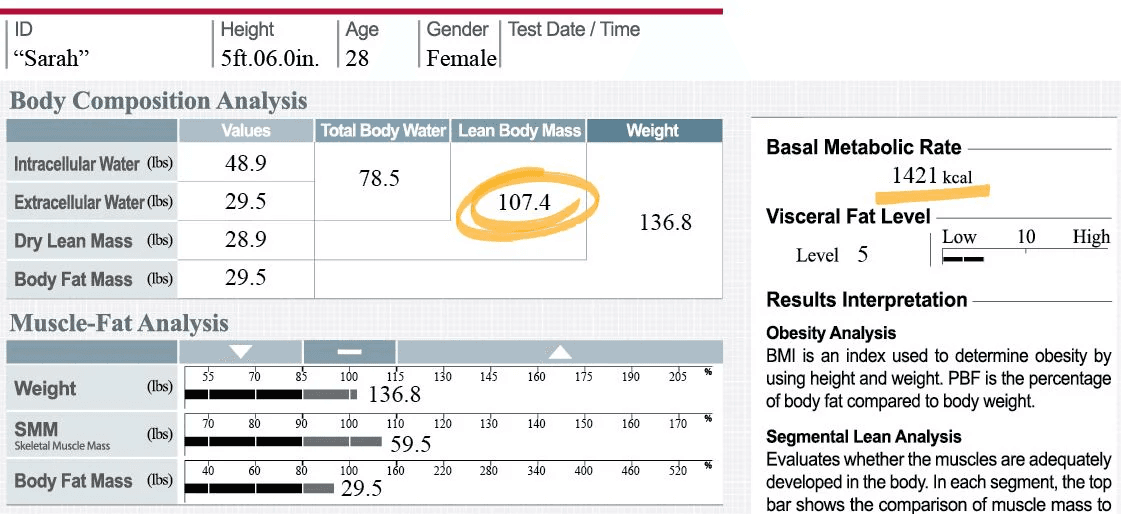
OK, you say, but these two people are very different in body weight – of course, the second person will have a bigger metabolism.  Take a look at the two people below, who we’ll call “Jane” and “Sarah”, two individuals who are similar body in age, height, weight, and gender.

Despite being similar in age, height, weight, and gender, these two people have very different body composition profiles.  As a result, they have different Basal Metabolic Rates. Although Jane has a body weight within the normal range (identified by being near the 100% mark), her body composition is defined by having more fat mass and less lean body mass and skeletal muscle than Sarah.

The person below has a lower body fat percentage and more Lean Body Mass – which is why when looking at this person, you’d describe them as “lean.”  Again, because this person has more than 10 pounds more Lean Body Mass, her Basal Metabolic Rate comes out over a hundred calories greater than the person above.

Metabolism and Weight Gain Over Time

Image Source: Flickr

Let’s take a deeper look at what you might call a “slow” metabolism. Far from being an issue of fastness or slowness, weight gain is almost always the result of a caloric imbalance that goes unchecked over a long period of time.

But first, something needs to be clarified – your Basal Metabolic Rate is not the only factor that plays into your overall caloric needs, and it’s not the total amount of calories you need in a day.  There are two other major influencers, which are:

  • Your energy level – how active you are

  • The thermic effect of food – the energy your body uses to digest your food

These taken together with your Basal Metabolic Rate provide your Total Daily Energy Expenditure (TDEE). This is the number of calories your body burns in a day.

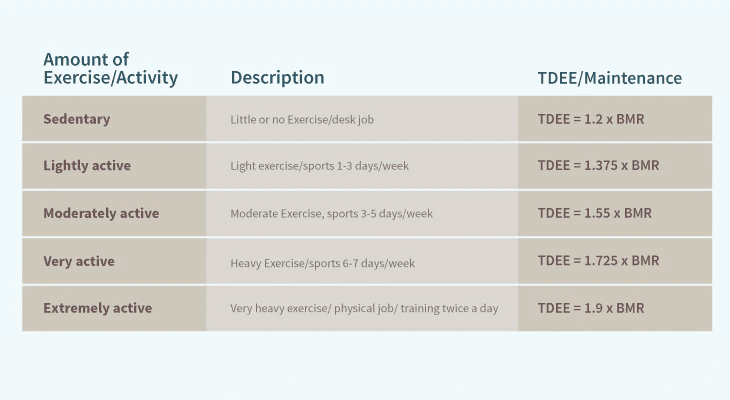
BMR is a necessary piece of information to estimate TDEE. Although they’re not exact, equations exist for estimating your TDEE based on your activity level and BMR. These are based on multiplying your BMR with an “activity factor” – a number between 1 and 2 – that increases the more active you are (and decreases when you are less active, regardless of your appetite).

To take a closer look into metabolism and weight gain, let’s take the two people whose body compositions we’ve looked at above, Jane and Sarah, and see what could happen in a real world example and accounting for diet and exercise.

For this exercise, we first need to estimate TDEE for Jane and Sarah, using their BMRs as a guide.  Based on Jane and Sarah’s compositions, it would be fair to assume that Jane does less exercise/is less active than Sarah, so we’ll assign an activity level of “Sedentary” for Jane and assign “Lightly Active” for Sarah.

Using these numbers and multiplying it by the appropriate activity factor, we can estimate Jane’s TDEE to be 1573 calories and Sarah’s to be 1953 calories, a difference of 380 calories.

Notice how although the difference in BMR was a little over 100 calories when activity levels are factored in, the difference in actual caloric needs becomes magnified.

Now that we have an estimate of the calories Jane and Sarah will need/burn in a day, let’s give them calories to take in. Let’s put them both on a diet of 1,800 calories a day – the estimated caloric intake suggested by the USDA for sedentary women between the ages of 26-30.

Assuming that Jane and Sarah both follow the 1,800 calorie diet perfectly without any extra, high caloric snacks or treats, Jane would end each day with a calorie surplus of 227 calories/day. Sarah would end each day in a slight calorie deficit of 153 calories a day.

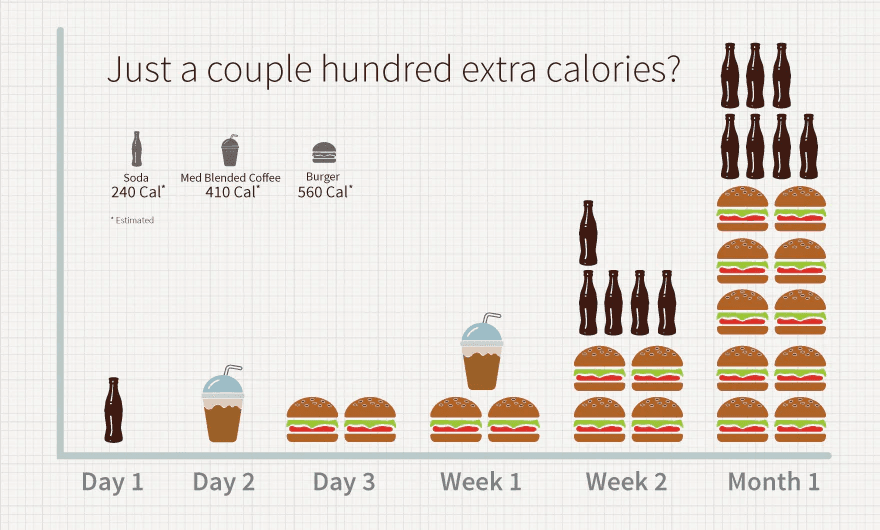
When you are in a caloric surplus – taking in more calories than you use – and live a mostly sedentary lifestyle, you will experience weight gain, specifically, fat. An extra 227 calories a day might not seem like a lot at first – that’s about a single soda -, but over time, a surplus of 227 calories a day becomes 1589 extra calories a week and a surplus of 7037 extra calorie a month: roughly 2 pounds of fat gain per month.

calorie surplus

Bottom line: despite being the same height, same gender, similar weight, and similar ages, because of the difference between Jane and Sarah’s body compositions, Jane will experience weight gain over time while Sarah might experience some weight loss (because of her calorie deficit), even though their diets are the same.  That’s because the differences in their caloric needs, although seemingly small at first, increase to significant differences when allowed to persist over time.

It’s not about their age or anything else; it’s about their body compositions determining their metabolism/caloric needs.

Making Your Metabolism Work For You

Because your metabolism isn’t something that slows down or speeds up depending on things like age, this actually gives you some control over it.  With the correct exercise and dietary plan, you can make your metabolism work for you

  • Improve and increase your metabolism

It all goes back to improving and maintaining a healthy body composition.

Because your body needs more energy to support itself when it has more Lean Body Mass, working to increase your Lean Body Mass can actually increase your Basal Metabolic Rate, which can have a huge impact on your TDEE once you factor in your activity level.

  • Avoid a decrease in your metabolism

For many people, simply maintaining their metabolism or avoiding a “slowdown” (which as we’ve seen, is a myth right up there with muscle turning into fat) is an important goal.

How can you avoid a decrease of your metabolism?

In short: by maintaining the Lean Body Mass that you already have.  That means maintaining your Skeletal Muscle Mass.

Your Skeletal Muscle Mass isn’t the same as your Lean Body Mass, but it is the overall biggest contributor to it. It’s the muscle that you can actually grow and develop through exercise, and increases/decreases in SMM have a strong influence on increases/decreases in Lean Body Mass.

Skeletal Muscle Mass is best developed through strength training and resistance exercise along with a proper diet.  A regular exercise plan that includes strength training and resistance exercise will help you maintain your Skeletal Muscle Mass.

This can be especially important as you age.  As people become older and busier, activity levels tend to drop and a proper diet can become harder to maintain as responsibilities increase.  Poor diet and nutrition can lead to loss of Lean Body Mass over time, which leads to a decrease in overall metabolism – not a slowdown.

  • Balance your diet and with your metabolism

The example of Jane is a good example of a well-intentioned dietary plan that doesn’t match the metabolism of the person practicing it.

Even though Jane has been led to believe that 1,800 calories is right for her based on age and gender, her metabolism doesn’t require that caloric intake, and she will end up gaining weight despite her efforts to eat a healthy diet. In the end, she will probably end up blaming her “slowing metabolism.”

It’s examples like Jane’s that show how important understanding the link between metabolism and body composition is.

How much Lean Body Mass do you have?  What might your Basal Metabolic Rate be?  These questions should be answered first before starting any weight loss or diet program, as well as conversations about metabolism.

The first step is always to get the information you need to get the answers to these questions by getting your body composition accurately tested.  Your metabolism and your body composition are strongly linked, so in order to truly understand your metabolism and weight, you must get your body composition tested.

Health

Feb 2, 2026

What Is Metabolic Age and How Does It Affect Your Health?

Your metabolic age is an important indicator of how well your body is functioning compared to your actual age. While your chronological age marks the passage of time, your metabolic age reflects how efficiently your metabolism is functioning.

It’s influenced by factors like your diet, exercise, and overall health. In this article, we’ll explain what metabolic age is, how it’s calculated, and share simple tips to help you improve it for better health.

What is Metabolic Age?

Infographic of male metabolic health data displaying 1800 BMR and 35-year-old metabolic age with a needle gauge indicating average health status.

Metabolic age is a comparison between your basal metabolic rate (BMR) and the average BMR of people in your chronological age group. In simpler terms, it tells you whether your metabolism is performing like that of someone younger, older, or right around your actual age.

Your basal metabolic rate represents the number of calories your body needs to perform basic life-sustaining functions while at rest (e.g., breathing, circulating blood, producing cells, and maintaining body temperature). It's essentially your body's baseline energy expenditure, accounting for roughly 60-75% of your total daily calorie burn.

When health professionals or body composition scales calculate your metabolic age, they're measuring your BMR and comparing it against population data. If your BMR is higher than average for your age group, you'll have a lower metabolic age. If it's lower than average, your metabolic age will be higher than your chronological age.

Here's a practical example: 

Let's say you're 45 years old, but your BMR matches the average BMR of a typical 35-year-old. Your metabolic age would be 35. Conversely, if your BMR matches that of a 55-year-old, your metabolic age would reflect that higher number.

The concept emerged from research into body composition and metabolic health, particularly as scientists recognized that chronological age alone doesn't tell the full story of someone's health status. Two people born on the same day can have vastly different metabolic profiles based on their lifestyle choices, genetics, and overall health.

It's worth noting that metabolic age isn't a standardized medical diagnostic tool in the way blood pressure or cholesterol levels are. Different devices and calculations may produce slightly different results because there's no universal formula or database. But, the underlying principle remains consistent: comparing your metabolism to population averages gives you a snapshot of your metabolic health relative to your peers.

What Metabolic Age Really Means for Your Health?

Your metabolic age can be a helpful reference point for understanding metabolic health trends, but it should be interpreted alongside other health markers.

  • Research suggests metabolic health is associated with longevity and lower risk of chronic conditions.

  • When your metabolic age is lower than your chronological age, it generally suggests several positive health markers. You likely have more lean muscle mass and less body fat, particularly visceral fat. Higher muscle mass increases your BMR because muscle tissue is metabolically active, meaning it burns calories even when you're sitting on the couch.

  • A younger metabolic age also typically indicates better insulin sensitivity, which means your body efficiently processes glucose and maintains stable blood sugar levels. This is often associated with better blood sugar control and cardiometabolic markers. Studies have shown that people with better metabolic health tend to have lower inflammation markers, healthier cholesterol profiles, and better blood pressure readings.

  • On the flip side, if your metabolic age is higher than your chronological age, it may reflect patterns such as higher body fat, lower muscle mass, or both. Research has linked a higher metabolic age to greater cardiometabolic risk, including higher risk of cardiovascular disease and future cardiovascular events. This is not a diagnosis, but it can be a useful signal to review lifestyle factors like activity, nutrition, sleep, and stress.

Metabolic Age vs. Chronological Age: What's the Difference?

Chronological age is the number of years since you were born. Metabolic age, by contrast, is dynamic and changeable.

You might be chronologically 50 but metabolically 40 if you've maintained excellent fitness, preserved muscle mass, and kept your body fat in check. Alternatively, a sedentary 30-year-old with poor dietary habits might have the metabolism of someone in their 40s or 50s.

The gap between these two ages reveals something critical: biological aging doesn't proceed at the same rate for everyone.  

One significant advantage of focusing on metabolic age rather than chronological age is that it shifts attention to factors you can control. You can't change when you were born, but you absolutely can influence your metabolic health through daily choices. This perspective empowers you to take ownership of your health trajectory.

Aspect

Chronological Age

Metabolic Age

Definition

The number of years since you were born.

A measure of how efficiently your body is functioning based on metabolism.

Changeability

Fixed and unchangeable.

Dynamic and can change based on lifestyle, fitness, and health choices.

Influencing Factors

Cannot be influenced.

Can be influenced by diet, exercise, muscle mass, and body fat.

How is Metabolic Age Calculated?

Infographic showing body composition analysis for a woman, including weight tracking, body fat percentage, and muscle mass measurements on a smart scale.

The calculation of metabolic age involves several steps and requires specific body composition data. While the exact algorithms vary between devices and calculation methods, the fundamental process follows a similar pattern.

Step 1: Determining Basal Metabolic Rate (BMR)

First, your basal metabolic rate (BMR) needs to be determined. BMR is the number of calories your body needs at rest to perform basic functions like breathing and maintaining body temperature.

There are several ways to measure or estimate BMR. The gold standard is indirect calorimetry, which measures oxygen consumption and carbon dioxide production to precisely calculate energy expenditure. However, this method requires specialized equipment and is typically only available in research or clinical settings.

Step 2: Using Bioelectrical Impedance Analysis (BIA)

More commonly, bioelectrical impedance analysis (BIA) devices estimate your body composition by sending a weak electrical current through your body. Since muscle and fat conduct electricity differently, the device can estimate your percentages of muscle mass, body fat, bone density, and water content. Many modern smart scales and body composition analyzers, such as InBody devices, use this technology to provide BIA-based estimates.

Step 3: Calculating BMR Using Mathematical Formulas

Once your body composition is known, mathematical formulas calculate your BMR. Several equations exist for this purpose, including the Harris-Benedict equation, the Mifflin-St Jeor equation, and the Katch-McArdle formula. These formulas consider variables like weight, height, age, sex, and lean body mass.

For example, the revised Harris-Benedict equation calculates BMR as:

  • For men:
    BMR = 88.362 + (13.397 × weight in kg) + (4.799 × height in cm) - (5.677 × age in years)

  • For women:
    BMR = 447.593 + (9.247 × weight in kg) + (3.098 × height in cm) - (4.330 × age in years)

The Katch-McArdle formula, which incorporates lean body mass, often provides more accurate results:

  • BMR = 370 + (21.6 × lean body mass in kg)

Step 4: Comparing BMR with Age Group Databases

Once your BMR is calculated, it’s compared against a database of average BMR values for different age groups. This database typically includes BMR data collected from thousands or millions of people across various ages. The comparison reveals where your metabolism falls on the spectrum.

If your BMR equals the average BMR for 35-year-olds, your metabolic age is 35, regardless of whether you’re actually 25, 35, or 45. The device or software essentially asks: “What age group does this person’s metabolism most closely resemble?”

It’s important to understand that different manufacturers may use different reference databases and proprietary algorithms.  

Also, some limitations exist with metabolic age calculations. They don't account for factors like hormonal variations, certain medical conditions, medications, or genetic variations that affect metabolism. Two people with identical body compositions might still have different actual metabolic rates due to thyroid function, mitochondrial efficiency, or other physiological differences that the calculation doesn't capture.

How to Improve Your Metabolic Age?

Fitness and wellness lifestyle graphic depicting strength training, healthy meal preparation, and the importance of sleep for recovery.

If your metabolic age is higher than you'd like, the good news is that you have significant power to improve it. The strategies that lower metabolic age are the same ones that improve overall health:

Build and Preserve Muscle Mass

Increasing your lean muscle mass is perhaps the most effective way to lower your metabolic age. Muscle tissue burns significantly more calories at rest than fat tissue does. Estimates of tissue-specific resting metabolic rates suggest skeletal muscle uses about 13 kcal per kg per day compared with about 4.5 kcal per kg per day for adipose tissue, which is roughly 6 versus 2 kcal per pound per day. Individual metabolic rate still depends on many factors, including total lean mass and organ activity.

Resistance training can play a major role in preserving muscle and supporting metabolic health. Aim for at least two to three strength training sessions per week, targeting all major muscle groups.  

As you age, you naturally lose muscle mass in a process called sarcopenia, which can start as early as your 30s and accelerate after 50. Counteracting this requires consistent effort, but the metabolic payoff is substantial. Progressive overload, gradually increasing the weight, reps, or difficulty of your exercises, ensures continued muscle growth.

Optimize Your Nutrition

What you eat profoundly affects your body composition and metabolic health. Prioritize protein intake, as protein supports muscle maintenance and growth. The Recommended Dietary Allowance for protein is 0.8 grams per kilogram of body weight, which is about 0.36 grams per pound. Some people may benefit from higher intakes depending on activity level and goals, but individual needs vary.

Avoid excessive calorie restriction, which can actually slow your metabolism. Severe dieting triggers adaptive thermogenesis, where your body becomes more efficient (burns fewer calories) to conserve energy. Instead, if weight loss is a goal, focus on moderate and sustainable changes in energy intake that you can maintain over time.

Focus on whole, minimally processed foods that provide nutrients without excess calories from added sugars and unhealthy fats. Adequate protein, healthy fats, and complex carbohydrates provide the building blocks your body needs for optimal metabolic function.

Don't skip meals or go extremely low-calorie for extended periods. Consistent, adequate nutrition supports metabolic health better than dramatic restriction followed by overeating.

Incorporate Cardiovascular Exercise

While cardio doesn't build muscle like resistance training does, it supports overall metabolic health, improves insulin sensitivity, and helps with fat loss. High-intensity interval training (HIIT) appears particularly effective for metabolic benefits, alternating short bursts of intense effort with recovery periods.

Aim for at least 150 minutes of moderate-intensity aerobic activity or 75 minutes of vigorous activity per week, as recommended by the CDC. This supports cardiovascular health, helps maintain a healthy weight, and improves your body's ability to process nutrients efficiently.

Prioritize Quality Sleep

Sleep deprivation wreaks havoc on metabolism. Poor sleep disrupts hormones like leptin and ghrelin that regulate hunger, increases cortisol (which promotes fat storage), and reduces insulin sensitivity. Chronic sleep debt is associated with weight gain, increased body fat, and muscle loss.

Aim for 7-9 hours of quality sleep per night. Establish consistent sleep and wake times, create a dark and cool sleeping environment, and limit screen time before bed. Think of sleep as a non-negotiable pillar of metabolic health, not a luxury.

Manage Stress Effectively

Chronic stress elevates cortisol, which promotes abdominal fat accumulation and can break down muscle tissue. High cortisol also impairs insulin sensitivity and can increase appetite and cravings for high-calorie foods.

Incorporate stress management techniques that work for you, meditation, yoga, deep breathing exercises, time in nature, or engaging hobbies. The specific method matters less than finding sustainable practices that genuinely reduce your stress levels.

Stay Hydrated and Limit Alcohol

Proper hydration supports all metabolic processes. Even mild dehydration can reduce metabolic rate slightly. Water also helps with appetite regulation and supports exercise performance.

Alcohol, meanwhile, can interfere with muscle protein synthesis, adds empty calories, and can disrupt sleep and recovery. Moderation or elimination of alcohol often leads to improvements in body composition and metabolic markers.

Be Patient and Consistent

Improving metabolic age doesn't happen overnight. Significant changes in body composition typically take weeks to months of consistent effort. Focus on building sustainable habits rather than seeking quick fixes. Small, consistent improvements compound over time into dramatic transformations.

Track your progress not just through metabolic age measurements but also through how you feel, your energy levels, exercise performance, and how your clothes fit. These subjective markers often improve before the numbers change significantly.

Key Takeaways

  • Metabolic age compares your basal metabolic rate (BMR) to the average BMR of people in your chronological age group, showing whether your metabolism functions like someone younger or older.

  • Understanding what metabolic age means can help you interpret trends related to body composition and metabolic health.

  • Building and preserving muscle mass through resistance training is the most effective way to lower your metabolic age, as muscle burns significantly more calories at rest than fat.

  • Your metabolic age is dynamic and responsive to lifestyle changes like nutrition, exercise, sleep quality, and stress management, unlike your fixed chronological age.

  • A metabolic age higher than your actual age serves as a warning sign for potential health issues, while a lower metabolic age typically indicates favorable body composition and better metabolic health.

  • Consistency in healthy habits matters more than quick fixes when improving metabolic age, as significant changes in body composition and metabolic function take weeks to months of sustained effort.

Frequently Asked Questions

What does metabolic age mean?

Metabolic age compares your basal metabolic rate (BMR) to the average BMR of people in your chronological age group. It indicates whether your metabolism functions like someone younger, older, or the same as your actual age based on body composition and energy expenditure.

How can I lower my metabolic age?

You can lower your metabolic age by building muscle through resistance training, eating adequate protein, incorporating cardio exercise, getting 7-9 hours of quality sleep, managing stress effectively, and maintaining a healthy body composition with less body fat and more lean muscle mass.

What is the difference between metabolic age and chronological age?

Chronological age is simply the number of years since you were born, which advances steadily and cannot be changed. Metabolic age is a functional measure of how efficiently your body burns energy, which can be improved or worsened based on lifestyle choices and health habits.

Is metabolic age an accurate indicator of health?

Metabolic age provides useful insight into metabolic health and body composition, but it's not a standardized medical diagnostic tool. Different devices may give varying results, and it should be considered alongside other health markers like blood pressure, cholesterol, and blood sugar levels.

Can you reverse your metabolic age?

Yes, metabolic age is changeable and responsive to lifestyle interventions. By increasing lean muscle mass, improving nutrition, exercising regularly, and adopting healthy sleep and stress management habits, you can effectively lower your metabolic age over time with consistent effort.

What causes a high metabolic age?

A high metabolic age typically results from excess body fat, insufficient muscle mass, sedentary lifestyle, poor nutrition, inadequate sleep, and chronic stress. These factors reduce your basal metabolic rate, making your metabolism function like someone older than your actual age.

Overhead view of healthy breakfast spread with waffles, oatmeal bowls, and berries

Health

May 29, 2019

Is It Possible to Boost Your Metabolism? The Truth About Metabolic Flexibility

Eat carbs before you work out. It will improve your performance. No, don’t – eat fats like peanut butter or avocados. No, actually, don’t eat at all and your body will burn more calories. Refuel with carbs. No, recover with protein to build muscle.

Is your head spinning yet?

You’re not alone if you ever feel like every health article you see contradicts the one you saw the day before.

If you stay up-to-date on health news and research, the very word “metabolism” may seem antiquated and overused. But it’s everywhere because it really IS that important. Your metabolism is the process (or series of processes, rather) that dictate how your body functions.

Even though the word appears ubiquitously, most of us misunderstand what metabolism really is and what it does. Yes, your metabolism determines how much and how often you need to eat, but most people overlook the fact that metabolic reactions take place in every single cell in your body.

“Metabolism” refers to the series of chemical processes in each cell that turn your food into energy to keep you alive. And because your metabolism is so complex, it’s able to use different sorts of fuel to your body’s advantage.

This is where the perpetual carbs-versus-fats debate comes into play. Everyone’s quick to tell you about their success with the Keto diet or how more balanced macros improved their performance in the gym.

In reality, there’s no perfect diet. Everyone’s preferred macronutrient ratio and calorie intake depend on their unique resting metabolic rate, activity level, food sensitivities, and more. But there is one thing everyone can count on: Your body will – or should – use what you give it.

What Is Metabolic Flexibility?

body composition a woman eating muffin

If you eat a lot of fats, fat will be your body’s primary source of fuel. If you eat a lot of carbohydrates, glucose will be your body’s primary source of fuel. If you eat more protein than anything else – you guessed it – your body will burn more protein for energy.

Metabolic flexibility is your body’s ability to adapt to metabolic demands. When things change – such as changing what time you eat breakfast or what you eat for breakfast – your body is forced to change the way it metabolizes your food.

When you eat, your food is either burned for energy or stored if what you ate was in excess of your energy needs. Any excess carbohydrates are stored as glycogen(which serves as quick energy reserves) or fat tissue if glycogen stores are full. Any extra fat is also put away for later use, as fat tissue.

How flexible your metabolism refers to how efficiently your body can switch between using carbs or fats for fuel – or, more importantly – how efficiently it can use what is already available.

Someone with great metabolic flexibility can burn carbs when they eat them. They can also burn fat when they eat it, or when they don’t eat at all. People with flexible metabolisms can “flex” between carbohydrate metabolism and fat oxidation relatively easily.

For example, a person with great metabolic flexibility does cardio in the morning on an empty stomach. Because their metabolism is highly flexible, their body powers through the workout on fat tissue that already exists. The same person, however, could eat oatmeal and a banana an hour or two before their workout and instead use those carbs as fuel (instead of storing them for later use).

Why Do We Need Metabolic Flexibility?

Why Everyone Needs Protein. Yes, Even You steak salad and fish on table

A flexible metabolism gives your body more leeway when determining what fuel source to use. Take the example of the person doing fasted cardio in the previous section. If that person was metabolically inflexible and exercised on an empty stomach, he or she would first burn through the glycogen (stored carbohydrates) in their body – leaving the fat untouched.

This is why it’s so hard for many people to burn fat: They are metabolically inflexible.

If you’re very metabolically flexible, eating calorie-dense, sugar-laden, or very fatty foods from time to time won’t always be an issue for your body. Your body can convert those calories into energy without much negative aftermath.  

Those who are metabolically flexible carry more mitochondria in their muscles, which allows them to produce energy more efficiently. Having too few mitochondria, or having dysfunctional mitochondria, limits the amount of energy a person can produce. It makes switching between fuels difficult, which makes utilizing any stored body fat between meals almost impossible. This is why metabolically inflexible people tend to snack often.

Side Effects of Metabolic Inflexibility

So we know now that the benefits of metabolic flexibility are vast. But what’s the big deal if we aren’t so good at flexing our metabolism muscle?

In simple terms, metabolically inflexible people generally feel pretty poor.

Side effects of metabolic inflexibility include fatigue, weight gain, brain fog, poor sleep, low mood or depression, poor cognitive function (poor ability to focus), and shortness of breath. If you find it hard to finish tasks at hand, taking frequent coffee breaks for caffeine-induced energy, getting frustrated easily, or having trouble sleeping, you may have an inflexible metabolism.

Additionally, metabolically inflexible people tend to be excessively hungry or have an unusually strong appetite. This is because their bodies aren’t good at burning what’s already there.

How to Train Your Metabolism to Be More Flexible

A ketogenic diet with fresh vegetables

The key to understanding metabolic flexibility is understanding how insulin regulates our energy. A healthy person with normal insulin action can effectively switch between fats and carbs as fuel. An insulin-resistant person cannot do this as effectively.

Insulin is the hormone that regulates your blood sugar by taking glucose into your bloodstream. There are two primary states of being as it relates to a person’s metabolism: fed and fasting.

During fed conditions (e.g., having just eaten), your insulin levels will be high due to incoming food. During fasting conditions, someone who is very metabolically flexible will easily be able to tap into stored body fat. The workings of insulin are vast, and you can learn more here, but these points are essential to understanding metabolic flexibility:

  • All food you eat, regardless of macronutrient composition, sparks the release of insulin.

  • Insulin is a factor in deciding which fuel source your body uses.

  • When insulin levels are low, your body primarily burns fat.

  • When insulin levels are high, your body primarily burns carbs and stores fat.

One of the best – and easiest – ways to improve your metabolic flexibility is to exercise. If you’re generally sedentary, adding exercise to your days is a surefire way to kick your body into a fat-burning mode it’s never experienced before. If you already exercise regularly, add more variety to your workouts.

Varying the type of training you do (strength training, intervals, and some sort of aerobic or endurance activity) might just give your body the nudge it needs to tap into your fat reserves. Different types of exercise use different mixes of fuel and eventually may train your body to use different fuel sources during day-to-day activities.

Fasted cardio is one type of exercise intended to tap heavily into your body’s fat reserves. Doing high-intensity cardiovascular exercise with little to no glycogen stored can train your metabolism to be more flexible.

Another way to improve your metabolic flexibility is intermittent fasting (IF). Remember the person who used body fat as fuel during their morning fasted cardio? That worked because his or her body was trained to use the available energy in the absence of food.

Metabolically inflexible people would just feel atrocious in the same scenario because their bodies don’t know how to function without incoming energy (food). If you can’t make it more than two-to-three hours without food, you’re impairing your body’s ability to utilize your body fat. Work slowly to increase your spacing between meals.

Timing your nutrient intake can help your body use fat more efficiently, and the longer the fasting period, the more your body has to tap into its fat reserves, which may be one way to combat obesity.

You should also test out different macronutrient ratios. The fewer carbohydrates you consume, the more your body will have to rely on fat sources for fuel. This is the premise behind the ketogenic diet. Try cutting out added sugars and overly processed grains first. Then you can try reducing your carb intake even further by cutting out starches like potatoes. If keto’s not for you, try out the paleo diet, which is also low in carbs and higher in fat and protein.

While it’s encouraged to consume fats, avoid trans fats and too many saturated fats. Try to get your fats from nutrient-dense sources like olive and coconut oils, avocados, nuts, seeds, and fatty fish.

Also, consume more antioxidant-rich foods: Antioxidant consumption has been linked to a reduced risk of metabolic syndrome, as well as an increase in insulin sensitivity.

A Flexible Metabolism Means More Energy, a Better Body Composition, and Improved Health

a group of people giving thumbs up

To sum up, metabolic flexibility is the ability to switch from one fuel source to the next: from fats to carbs and vice versa. Metabolic inflexibility is the opposite: the inability (or limited ability) to switch from one fuel source to the other. For those concerned with body composition, inflexibility can be a real downer because it’s impossible to lose body fat if your body can’t burn it.

A flexible metabolism is efficient at using excess adipose tissue (fat) for energy, which over time decreases the ratio of fat mass to lean mass, resulting in a better body composition and decreased heatlh risk.

It’s hypothesized that metabolic inflexibility also plays a role in various diseases processes such as metabolic syndrome; so along with better body composition, being metabolically flexible can improve overall health and wellness by boosting insulin sensitivity, reducing the risk of disease, and training your body to adapt to metabolic demands.

Though this may all seem too complex to try, it’s not really that complicated: Think about your ancestors, what they ate, how much, and how often. It’s no secret that whole-food nutrition (fruits, vegetables, lean protein, nuts, and seeds) and exercise are the keys to a lean, healthy body.

Training your body to endure longer periods of time without food is also key to mastering fat-burning mode. Our hunter-gatherer predecessors didn’t have access to the abundance of food we do. They were forced to go long periods of time without eating, and thus their metabolisms kept them alive by burning what fat they had stored on their bodies.

If you’re interested in improving your body composition or general wellness, it’s worth experimenting with exercise, fasting, and macronutrients to train your metabolism to be flexible.

**

Amanda Capritto is a certified personal trainer and health coach who writes about nutrition, fitness and healthcare. A journalism alumna of Louisiana State University, Amanda spends her free time adventuring outdoors, hitting the gym, and encouraging people to live balanced, healthy lifestyles.

Cup of tea beside notepad with BMR and basal metabolic rate notes

Fitness

Oct 6, 2018

Your Metabolism and Your Body Composition

Editor’s Note: This post was updated on October 5, 2018, for accuracy and comprehensiveness. It was originally published on February 10, 2016

You probably don’t think about your body composition when you’re thinking about your metabolism. But you should.

You probably think about it in terms of speed: “My metabolism is fast” or “my metabolism is slowing down.”  If that sounds like you, you’re not alone: simply googling the word “metabolism” yields 4 articles in the top 10 all based around boosting/increasing your metabolism for weight loss.

People are naturally afraid of their metabolism slowing and the weight gain they know comes with it. To some extent, those worries are well-founded.

Metabolism is linked with weight gain and loss because of its a biological process involved with energy and calories.  

The Mayo Clinic defines metabolism as:

…the process by which your body converts what you eat and drink into energy. During this complex biochemical process, calories in food and beverages are combined with oxygen to release the energy your body needs to function.

Notice how it doesn’t mention anything about the speed you process your food. That would be digestion.

In medical terminology, metabolism is known as your Basal Metabolic Rate (BMR), which is the minimum number of calories your body needs to perform basic bodily functions. BMR is usually expressed in terms of calories.  Your Basal Metabolic Rate also has another interesting quality: the more Lean Body Mass (which includes muscle, water, and minerals) you have, the greater your BMR will be.

When we talk about metabolism, we should always start the conversation with how many calories your body needs. But because your BMR and Lean Body Mass are linked, that means any conversation about metabolism becomes a conversation about your body composition.

Your Body Composition Is Linked To Your Metabolism

Why is it that some people seem to be able to eat whatever they want and never experience any weight gain, while other people – even skinny people – feel like whenever they have one bite of dessert it instantly goes to their waistline?

The reason is that metabolism can vary in size.

Take a look at these two body composition profiles, and see if you can spot the difference.

Beyond the obvious differences in weight, the Person A has a much smaller Basal Metabolic Rate than the second.  This means Person B needs more calories than Person A in order to provide their body with the necessary energy to function without losing weight.  Because the BMR is bigger, the metabolism is “bigger.”

Greater than height and gender, the most important factor playing into BMR is the amount Lean Body Mass each person has.  That’s because, as research in the American Journal of Clinical Nutrition states, the more Lean Body Mass you have, the greater your Basal Metabolic Rate will be. That is why strength training for muscle gain, which in turn will increase your lean body mass, is recommended as a way to increase your metabolism.

This is why people who are big or above average in weight can eat more than people who are smaller.  Their body literally requires them to eat more to maintain their weight, and specifically – their Lean Body Mass.

OK, you say, but these two people are very different in body weight – of course, the second person will have a bigger metabolism.  Take a look at the two people below, who we’ll call “Jane” and “Sarah”, two individuals who are similar body in age, height, weight, and gender.

Despite being similar in age, height, weight, and gender, these two people have very different body composition profiles.  As a result, they have different Basal Metabolic Rates. Although Jane has a body weight within the normal range (identified by being near the 100% mark), her body composition is defined by having more fat mass and less lean body mass and skeletal muscle than Sarah.

The person below has a lower body fat percentage and more Lean Body Mass – which is why when looking at this person, you’d describe them as “lean.”  Again, because this person has more than 10 pounds more Lean Body Mass, her Basal Metabolic Rate comes out over a hundred calories greater than the person above.

Metabolism and Weight Gain Over Time

Image Source: Flickr

Let’s take a deeper look at what you might call a “slow” metabolism. Far from being an issue of fastness or slowness, weight gain is almost always the result of a caloric imbalance that goes unchecked over a long period of time.

But first, something needs to be clarified – your Basal Metabolic Rate is not the only factor that plays into your overall caloric needs, and it’s not the total amount of calories you need in a day.  There are two other major influencers, which are:

  • Your energy level – how active you are

  • The thermic effect of food – the energy your body uses to digest your food

These taken together with your Basal Metabolic Rate provide your Total Daily Energy Expenditure (TDEE). This is the number of calories your body burns in a day.

BMR is a necessary piece of information to estimate TDEE. Although they’re not exact, equations exist for estimating your TDEE based on your activity level and BMR. These are based on multiplying your BMR with an “activity factor” – a number between 1 and 2 – that increases the more active you are (and decreases when you are less active, regardless of your appetite).

To take a closer look into metabolism and weight gain, let’s take the two people whose body compositions we’ve looked at above, Jane and Sarah, and see what could happen in a real world example and accounting for diet and exercise.

For this exercise, we first need to estimate TDEE for Jane and Sarah, using their BMRs as a guide.  Based on Jane and Sarah’s compositions, it would be fair to assume that Jane does less exercise/is less active than Sarah, so we’ll assign an activity level of “Sedentary” for Jane and assign “Lightly Active” for Sarah.

Using these numbers and multiplying it by the appropriate activity factor, we can estimate Jane’s TDEE to be 1573 calories and Sarah’s to be 1953 calories, a difference of 380 calories.

Notice how although the difference in BMR was a little over 100 calories when activity levels are factored in, the difference in actual caloric needs becomes magnified.

Now that we have an estimate of the calories Jane and Sarah will need/burn in a day, let’s give them calories to take in. Let’s put them both on a diet of 1,800 calories a day – the estimated caloric intake suggested by the USDA for sedentary women between the ages of 26-30.

Assuming that Jane and Sarah both follow the 1,800 calorie diet perfectly without any extra, high caloric snacks or treats, Jane would end each day with a calorie surplus of 227 calories/day. Sarah would end each day in a slight calorie deficit of 153 calories a day.

When you are in a caloric surplus – taking in more calories than you use – and live a mostly sedentary lifestyle, you will experience weight gain, specifically, fat. An extra 227 calories a day might not seem like a lot at first – that’s about a single soda -, but over time, a surplus of 227 calories a day becomes 1589 extra calories a week and a surplus of 7037 extra calorie a month: roughly 2 pounds of fat gain per month.

calorie surplus

Bottom line: despite being the same height, same gender, similar weight, and similar ages, because of the difference between Jane and Sarah’s body compositions, Jane will experience weight gain over time while Sarah might experience some weight loss (because of her calorie deficit), even though their diets are the same.  That’s because the differences in their caloric needs, although seemingly small at first, increase to significant differences when allowed to persist over time.

It’s not about their age or anything else; it’s about their body compositions determining their metabolism/caloric needs.

Making Your Metabolism Work For You

Because your metabolism isn’t something that slows down or speeds up depending on things like age, this actually gives you some control over it.  With the correct exercise and dietary plan, you can make your metabolism work for you

  • Improve and increase your metabolism

It all goes back to improving and maintaining a healthy body composition.

Because your body needs more energy to support itself when it has more Lean Body Mass, working to increase your Lean Body Mass can actually increase your Basal Metabolic Rate, which can have a huge impact on your TDEE once you factor in your activity level.

  • Avoid a decrease in your metabolism

For many people, simply maintaining their metabolism or avoiding a “slowdown” (which as we’ve seen, is a myth right up there with muscle turning into fat) is an important goal.

How can you avoid a decrease of your metabolism?

In short: by maintaining the Lean Body Mass that you already have.  That means maintaining your Skeletal Muscle Mass.

Your Skeletal Muscle Mass isn’t the same as your Lean Body Mass, but it is the overall biggest contributor to it. It’s the muscle that you can actually grow and develop through exercise, and increases/decreases in SMM have a strong influence on increases/decreases in Lean Body Mass.

Skeletal Muscle Mass is best developed through strength training and resistance exercise along with a proper diet.  A regular exercise plan that includes strength training and resistance exercise will help you maintain your Skeletal Muscle Mass.

This can be especially important as you age.  As people become older and busier, activity levels tend to drop and a proper diet can become harder to maintain as responsibilities increase.  Poor diet and nutrition can lead to loss of Lean Body Mass over time, which leads to a decrease in overall metabolism – not a slowdown.

  • Balance your diet and with your metabolism

The example of Jane is a good example of a well-intentioned dietary plan that doesn’t match the metabolism of the person practicing it.

Even though Jane has been led to believe that 1,800 calories is right for her based on age and gender, her metabolism doesn’t require that caloric intake, and she will end up gaining weight despite her efforts to eat a healthy diet. In the end, she will probably end up blaming her “slowing metabolism.”

It’s examples like Jane’s that show how important understanding the link between metabolism and body composition is.

How much Lean Body Mass do you have?  What might your Basal Metabolic Rate be?  These questions should be answered first before starting any weight loss or diet program, as well as conversations about metabolism.

The first step is always to get the information you need to get the answers to these questions by getting your body composition accurately tested.  Your metabolism and your body composition are strongly linked, so in order to truly understand your metabolism and weight, you must get your body composition tested.

Health

Feb 2, 2026

What Is Metabolic Age and How Does It Affect Your Health?

Your metabolic age is an important indicator of how well your body is functioning compared to your actual age. While your chronological age marks the passage of time, your metabolic age reflects how efficiently your metabolism is functioning.

It’s influenced by factors like your diet, exercise, and overall health. In this article, we’ll explain what metabolic age is, how it’s calculated, and share simple tips to help you improve it for better health.

What is Metabolic Age?

Infographic of male metabolic health data displaying 1800 BMR and 35-year-old metabolic age with a needle gauge indicating average health status.

Metabolic age is a comparison between your basal metabolic rate (BMR) and the average BMR of people in your chronological age group. In simpler terms, it tells you whether your metabolism is performing like that of someone younger, older, or right around your actual age.

Your basal metabolic rate represents the number of calories your body needs to perform basic life-sustaining functions while at rest (e.g., breathing, circulating blood, producing cells, and maintaining body temperature). It's essentially your body's baseline energy expenditure, accounting for roughly 60-75% of your total daily calorie burn.

When health professionals or body composition scales calculate your metabolic age, they're measuring your BMR and comparing it against population data. If your BMR is higher than average for your age group, you'll have a lower metabolic age. If it's lower than average, your metabolic age will be higher than your chronological age.

Here's a practical example: 

Let's say you're 45 years old, but your BMR matches the average BMR of a typical 35-year-old. Your metabolic age would be 35. Conversely, if your BMR matches that of a 55-year-old, your metabolic age would reflect that higher number.

The concept emerged from research into body composition and metabolic health, particularly as scientists recognized that chronological age alone doesn't tell the full story of someone's health status. Two people born on the same day can have vastly different metabolic profiles based on their lifestyle choices, genetics, and overall health.

It's worth noting that metabolic age isn't a standardized medical diagnostic tool in the way blood pressure or cholesterol levels are. Different devices and calculations may produce slightly different results because there's no universal formula or database. But, the underlying principle remains consistent: comparing your metabolism to population averages gives you a snapshot of your metabolic health relative to your peers.

What Metabolic Age Really Means for Your Health?

Your metabolic age can be a helpful reference point for understanding metabolic health trends, but it should be interpreted alongside other health markers.

  • Research suggests metabolic health is associated with longevity and lower risk of chronic conditions.

  • When your metabolic age is lower than your chronological age, it generally suggests several positive health markers. You likely have more lean muscle mass and less body fat, particularly visceral fat. Higher muscle mass increases your BMR because muscle tissue is metabolically active, meaning it burns calories even when you're sitting on the couch.

  • A younger metabolic age also typically indicates better insulin sensitivity, which means your body efficiently processes glucose and maintains stable blood sugar levels. This is often associated with better blood sugar control and cardiometabolic markers. Studies have shown that people with better metabolic health tend to have lower inflammation markers, healthier cholesterol profiles, and better blood pressure readings.

  • On the flip side, if your metabolic age is higher than your chronological age, it may reflect patterns such as higher body fat, lower muscle mass, or both. Research has linked a higher metabolic age to greater cardiometabolic risk, including higher risk of cardiovascular disease and future cardiovascular events. This is not a diagnosis, but it can be a useful signal to review lifestyle factors like activity, nutrition, sleep, and stress.

Metabolic Age vs. Chronological Age: What's the Difference?

Chronological age is the number of years since you were born. Metabolic age, by contrast, is dynamic and changeable.

You might be chronologically 50 but metabolically 40 if you've maintained excellent fitness, preserved muscle mass, and kept your body fat in check. Alternatively, a sedentary 30-year-old with poor dietary habits might have the metabolism of someone in their 40s or 50s.

The gap between these two ages reveals something critical: biological aging doesn't proceed at the same rate for everyone.  

One significant advantage of focusing on metabolic age rather than chronological age is that it shifts attention to factors you can control. You can't change when you were born, but you absolutely can influence your metabolic health through daily choices. This perspective empowers you to take ownership of your health trajectory.

Aspect

Chronological Age

Metabolic Age

Definition

The number of years since you were born.

A measure of how efficiently your body is functioning based on metabolism.

Changeability

Fixed and unchangeable.

Dynamic and can change based on lifestyle, fitness, and health choices.

Influencing Factors

Cannot be influenced.

Can be influenced by diet, exercise, muscle mass, and body fat.

How is Metabolic Age Calculated?

Infographic showing body composition analysis for a woman, including weight tracking, body fat percentage, and muscle mass measurements on a smart scale.

The calculation of metabolic age involves several steps and requires specific body composition data. While the exact algorithms vary between devices and calculation methods, the fundamental process follows a similar pattern.

Step 1: Determining Basal Metabolic Rate (BMR)

First, your basal metabolic rate (BMR) needs to be determined. BMR is the number of calories your body needs at rest to perform basic functions like breathing and maintaining body temperature.

There are several ways to measure or estimate BMR. The gold standard is indirect calorimetry, which measures oxygen consumption and carbon dioxide production to precisely calculate energy expenditure. However, this method requires specialized equipment and is typically only available in research or clinical settings.

Step 2: Using Bioelectrical Impedance Analysis (BIA)

More commonly, bioelectrical impedance analysis (BIA) devices estimate your body composition by sending a weak electrical current through your body. Since muscle and fat conduct electricity differently, the device can estimate your percentages of muscle mass, body fat, bone density, and water content. Many modern smart scales and body composition analyzers, such as InBody devices, use this technology to provide BIA-based estimates.

Step 3: Calculating BMR Using Mathematical Formulas

Once your body composition is known, mathematical formulas calculate your BMR. Several equations exist for this purpose, including the Harris-Benedict equation, the Mifflin-St Jeor equation, and the Katch-McArdle formula. These formulas consider variables like weight, height, age, sex, and lean body mass.

For example, the revised Harris-Benedict equation calculates BMR as:

  • For men:
    BMR = 88.362 + (13.397 × weight in kg) + (4.799 × height in cm) - (5.677 × age in years)

  • For women:
    BMR = 447.593 + (9.247 × weight in kg) + (3.098 × height in cm) - (4.330 × age in years)

The Katch-McArdle formula, which incorporates lean body mass, often provides more accurate results:

  • BMR = 370 + (21.6 × lean body mass in kg)

Step 4: Comparing BMR with Age Group Databases

Once your BMR is calculated, it’s compared against a database of average BMR values for different age groups. This database typically includes BMR data collected from thousands or millions of people across various ages. The comparison reveals where your metabolism falls on the spectrum.

If your BMR equals the average BMR for 35-year-olds, your metabolic age is 35, regardless of whether you’re actually 25, 35, or 45. The device or software essentially asks: “What age group does this person’s metabolism most closely resemble?”

It’s important to understand that different manufacturers may use different reference databases and proprietary algorithms.  

Also, some limitations exist with metabolic age calculations. They don't account for factors like hormonal variations, certain medical conditions, medications, or genetic variations that affect metabolism. Two people with identical body compositions might still have different actual metabolic rates due to thyroid function, mitochondrial efficiency, or other physiological differences that the calculation doesn't capture.

How to Improve Your Metabolic Age?

Fitness and wellness lifestyle graphic depicting strength training, healthy meal preparation, and the importance of sleep for recovery.

If your metabolic age is higher than you'd like, the good news is that you have significant power to improve it. The strategies that lower metabolic age are the same ones that improve overall health:

Build and Preserve Muscle Mass

Increasing your lean muscle mass is perhaps the most effective way to lower your metabolic age. Muscle tissue burns significantly more calories at rest than fat tissue does. Estimates of tissue-specific resting metabolic rates suggest skeletal muscle uses about 13 kcal per kg per day compared with about 4.5 kcal per kg per day for adipose tissue, which is roughly 6 versus 2 kcal per pound per day. Individual metabolic rate still depends on many factors, including total lean mass and organ activity.

Resistance training can play a major role in preserving muscle and supporting metabolic health. Aim for at least two to three strength training sessions per week, targeting all major muscle groups.  

As you age, you naturally lose muscle mass in a process called sarcopenia, which can start as early as your 30s and accelerate after 50. Counteracting this requires consistent effort, but the metabolic payoff is substantial. Progressive overload, gradually increasing the weight, reps, or difficulty of your exercises, ensures continued muscle growth.

Optimize Your Nutrition

What you eat profoundly affects your body composition and metabolic health. Prioritize protein intake, as protein supports muscle maintenance and growth. The Recommended Dietary Allowance for protein is 0.8 grams per kilogram of body weight, which is about 0.36 grams per pound. Some people may benefit from higher intakes depending on activity level and goals, but individual needs vary.

Avoid excessive calorie restriction, which can actually slow your metabolism. Severe dieting triggers adaptive thermogenesis, where your body becomes more efficient (burns fewer calories) to conserve energy. Instead, if weight loss is a goal, focus on moderate and sustainable changes in energy intake that you can maintain over time.

Focus on whole, minimally processed foods that provide nutrients without excess calories from added sugars and unhealthy fats. Adequate protein, healthy fats, and complex carbohydrates provide the building blocks your body needs for optimal metabolic function.

Don't skip meals or go extremely low-calorie for extended periods. Consistent, adequate nutrition supports metabolic health better than dramatic restriction followed by overeating.

Incorporate Cardiovascular Exercise

While cardio doesn't build muscle like resistance training does, it supports overall metabolic health, improves insulin sensitivity, and helps with fat loss. High-intensity interval training (HIIT) appears particularly effective for metabolic benefits, alternating short bursts of intense effort with recovery periods.

Aim for at least 150 minutes of moderate-intensity aerobic activity or 75 minutes of vigorous activity per week, as recommended by the CDC. This supports cardiovascular health, helps maintain a healthy weight, and improves your body's ability to process nutrients efficiently.

Prioritize Quality Sleep

Sleep deprivation wreaks havoc on metabolism. Poor sleep disrupts hormones like leptin and ghrelin that regulate hunger, increases cortisol (which promotes fat storage), and reduces insulin sensitivity. Chronic sleep debt is associated with weight gain, increased body fat, and muscle loss.

Aim for 7-9 hours of quality sleep per night. Establish consistent sleep and wake times, create a dark and cool sleeping environment, and limit screen time before bed. Think of sleep as a non-negotiable pillar of metabolic health, not a luxury.

Manage Stress Effectively

Chronic stress elevates cortisol, which promotes abdominal fat accumulation and can break down muscle tissue. High cortisol also impairs insulin sensitivity and can increase appetite and cravings for high-calorie foods.

Incorporate stress management techniques that work for you, meditation, yoga, deep breathing exercises, time in nature, or engaging hobbies. The specific method matters less than finding sustainable practices that genuinely reduce your stress levels.

Stay Hydrated and Limit Alcohol

Proper hydration supports all metabolic processes. Even mild dehydration can reduce metabolic rate slightly. Water also helps with appetite regulation and supports exercise performance.

Alcohol, meanwhile, can interfere with muscle protein synthesis, adds empty calories, and can disrupt sleep and recovery. Moderation or elimination of alcohol often leads to improvements in body composition and metabolic markers.

Be Patient and Consistent

Improving metabolic age doesn't happen overnight. Significant changes in body composition typically take weeks to months of consistent effort. Focus on building sustainable habits rather than seeking quick fixes. Small, consistent improvements compound over time into dramatic transformations.

Track your progress not just through metabolic age measurements but also through how you feel, your energy levels, exercise performance, and how your clothes fit. These subjective markers often improve before the numbers change significantly.

Key Takeaways

  • Metabolic age compares your basal metabolic rate (BMR) to the average BMR of people in your chronological age group, showing whether your metabolism functions like someone younger or older.

  • Understanding what metabolic age means can help you interpret trends related to body composition and metabolic health.

  • Building and preserving muscle mass through resistance training is the most effective way to lower your metabolic age, as muscle burns significantly more calories at rest than fat.

  • Your metabolic age is dynamic and responsive to lifestyle changes like nutrition, exercise, sleep quality, and stress management, unlike your fixed chronological age.

  • A metabolic age higher than your actual age serves as a warning sign for potential health issues, while a lower metabolic age typically indicates favorable body composition and better metabolic health.

  • Consistency in healthy habits matters more than quick fixes when improving metabolic age, as significant changes in body composition and metabolic function take weeks to months of sustained effort.

Frequently Asked Questions

What does metabolic age mean?

Metabolic age compares your basal metabolic rate (BMR) to the average BMR of people in your chronological age group. It indicates whether your metabolism functions like someone younger, older, or the same as your actual age based on body composition and energy expenditure.

How can I lower my metabolic age?

You can lower your metabolic age by building muscle through resistance training, eating adequate protein, incorporating cardio exercise, getting 7-9 hours of quality sleep, managing stress effectively, and maintaining a healthy body composition with less body fat and more lean muscle mass.

What is the difference between metabolic age and chronological age?

Chronological age is simply the number of years since you were born, which advances steadily and cannot be changed. Metabolic age is a functional measure of how efficiently your body burns energy, which can be improved or worsened based on lifestyle choices and health habits.

Is metabolic age an accurate indicator of health?

Metabolic age provides useful insight into metabolic health and body composition, but it's not a standardized medical diagnostic tool. Different devices may give varying results, and it should be considered alongside other health markers like blood pressure, cholesterol, and blood sugar levels.

Can you reverse your metabolic age?

Yes, metabolic age is changeable and responsive to lifestyle interventions. By increasing lean muscle mass, improving nutrition, exercising regularly, and adopting healthy sleep and stress management habits, you can effectively lower your metabolic age over time with consistent effort.

What causes a high metabolic age?

A high metabolic age typically results from excess body fat, insufficient muscle mass, sedentary lifestyle, poor nutrition, inadequate sleep, and chronic stress. These factors reduce your basal metabolic rate, making your metabolism function like someone older than your actual age.

Overhead view of healthy breakfast spread with waffles, oatmeal bowls, and berries

Health

May 29, 2019

Is It Possible to Boost Your Metabolism? The Truth About Metabolic Flexibility

Eat carbs before you work out. It will improve your performance. No, don’t – eat fats like peanut butter or avocados. No, actually, don’t eat at all and your body will burn more calories. Refuel with carbs. No, recover with protein to build muscle.

Is your head spinning yet?

You’re not alone if you ever feel like every health article you see contradicts the one you saw the day before.

If you stay up-to-date on health news and research, the very word “metabolism” may seem antiquated and overused. But it’s everywhere because it really IS that important. Your metabolism is the process (or series of processes, rather) that dictate how your body functions.

Even though the word appears ubiquitously, most of us misunderstand what metabolism really is and what it does. Yes, your metabolism determines how much and how often you need to eat, but most people overlook the fact that metabolic reactions take place in every single cell in your body.

“Metabolism” refers to the series of chemical processes in each cell that turn your food into energy to keep you alive. And because your metabolism is so complex, it’s able to use different sorts of fuel to your body’s advantage.

This is where the perpetual carbs-versus-fats debate comes into play. Everyone’s quick to tell you about their success with the Keto diet or how more balanced macros improved their performance in the gym.

In reality, there’s no perfect diet. Everyone’s preferred macronutrient ratio and calorie intake depend on their unique resting metabolic rate, activity level, food sensitivities, and more. But there is one thing everyone can count on: Your body will – or should – use what you give it.

What Is Metabolic Flexibility?

body composition a woman eating muffin

If you eat a lot of fats, fat will be your body’s primary source of fuel. If you eat a lot of carbohydrates, glucose will be your body’s primary source of fuel. If you eat more protein than anything else – you guessed it – your body will burn more protein for energy.

Metabolic flexibility is your body’s ability to adapt to metabolic demands. When things change – such as changing what time you eat breakfast or what you eat for breakfast – your body is forced to change the way it metabolizes your food.

When you eat, your food is either burned for energy or stored if what you ate was in excess of your energy needs. Any excess carbohydrates are stored as glycogen(which serves as quick energy reserves) or fat tissue if glycogen stores are full. Any extra fat is also put away for later use, as fat tissue.

How flexible your metabolism refers to how efficiently your body can switch between using carbs or fats for fuel – or, more importantly – how efficiently it can use what is already available.

Someone with great metabolic flexibility can burn carbs when they eat them. They can also burn fat when they eat it, or when they don’t eat at all. People with flexible metabolisms can “flex” between carbohydrate metabolism and fat oxidation relatively easily.

For example, a person with great metabolic flexibility does cardio in the morning on an empty stomach. Because their metabolism is highly flexible, their body powers through the workout on fat tissue that already exists. The same person, however, could eat oatmeal and a banana an hour or two before their workout and instead use those carbs as fuel (instead of storing them for later use).

Why Do We Need Metabolic Flexibility?

Why Everyone Needs Protein. Yes, Even You steak salad and fish on table

A flexible metabolism gives your body more leeway when determining what fuel source to use. Take the example of the person doing fasted cardio in the previous section. If that person was metabolically inflexible and exercised on an empty stomach, he or she would first burn through the glycogen (stored carbohydrates) in their body – leaving the fat untouched.

This is why it’s so hard for many people to burn fat: They are metabolically inflexible.

If you’re very metabolically flexible, eating calorie-dense, sugar-laden, or very fatty foods from time to time won’t always be an issue for your body. Your body can convert those calories into energy without much negative aftermath.  

Those who are metabolically flexible carry more mitochondria in their muscles, which allows them to produce energy more efficiently. Having too few mitochondria, or having dysfunctional mitochondria, limits the amount of energy a person can produce. It makes switching between fuels difficult, which makes utilizing any stored body fat between meals almost impossible. This is why metabolically inflexible people tend to snack often.

Side Effects of Metabolic Inflexibility

So we know now that the benefits of metabolic flexibility are vast. But what’s the big deal if we aren’t so good at flexing our metabolism muscle?

In simple terms, metabolically inflexible people generally feel pretty poor.

Side effects of metabolic inflexibility include fatigue, weight gain, brain fog, poor sleep, low mood or depression, poor cognitive function (poor ability to focus), and shortness of breath. If you find it hard to finish tasks at hand, taking frequent coffee breaks for caffeine-induced energy, getting frustrated easily, or having trouble sleeping, you may have an inflexible metabolism.

Additionally, metabolically inflexible people tend to be excessively hungry or have an unusually strong appetite. This is because their bodies aren’t good at burning what’s already there.

How to Train Your Metabolism to Be More Flexible

A ketogenic diet with fresh vegetables

The key to understanding metabolic flexibility is understanding how insulin regulates our energy. A healthy person with normal insulin action can effectively switch between fats and carbs as fuel. An insulin-resistant person cannot do this as effectively.

Insulin is the hormone that regulates your blood sugar by taking glucose into your bloodstream. There are two primary states of being as it relates to a person’s metabolism: fed and fasting.

During fed conditions (e.g., having just eaten), your insulin levels will be high due to incoming food. During fasting conditions, someone who is very metabolically flexible will easily be able to tap into stored body fat. The workings of insulin are vast, and you can learn more here, but these points are essential to understanding metabolic flexibility:

  • All food you eat, regardless of macronutrient composition, sparks the release of insulin.

  • Insulin is a factor in deciding which fuel source your body uses.

  • When insulin levels are low, your body primarily burns fat.

  • When insulin levels are high, your body primarily burns carbs and stores fat.

One of the best – and easiest – ways to improve your metabolic flexibility is to exercise. If you’re generally sedentary, adding exercise to your days is a surefire way to kick your body into a fat-burning mode it’s never experienced before. If you already exercise regularly, add more variety to your workouts.

Varying the type of training you do (strength training, intervals, and some sort of aerobic or endurance activity) might just give your body the nudge it needs to tap into your fat reserves. Different types of exercise use different mixes of fuel and eventually may train your body to use different fuel sources during day-to-day activities.

Fasted cardio is one type of exercise intended to tap heavily into your body’s fat reserves. Doing high-intensity cardiovascular exercise with little to no glycogen stored can train your metabolism to be more flexible.

Another way to improve your metabolic flexibility is intermittent fasting (IF). Remember the person who used body fat as fuel during their morning fasted cardio? That worked because his or her body was trained to use the available energy in the absence of food.

Metabolically inflexible people would just feel atrocious in the same scenario because their bodies don’t know how to function without incoming energy (food). If you can’t make it more than two-to-three hours without food, you’re impairing your body’s ability to utilize your body fat. Work slowly to increase your spacing between meals.

Timing your nutrient intake can help your body use fat more efficiently, and the longer the fasting period, the more your body has to tap into its fat reserves, which may be one way to combat obesity.

You should also test out different macronutrient ratios. The fewer carbohydrates you consume, the more your body will have to rely on fat sources for fuel. This is the premise behind the ketogenic diet. Try cutting out added sugars and overly processed grains first. Then you can try reducing your carb intake even further by cutting out starches like potatoes. If keto’s not for you, try out the paleo diet, which is also low in carbs and higher in fat and protein.

While it’s encouraged to consume fats, avoid trans fats and too many saturated fats. Try to get your fats from nutrient-dense sources like olive and coconut oils, avocados, nuts, seeds, and fatty fish.

Also, consume more antioxidant-rich foods: Antioxidant consumption has been linked to a reduced risk of metabolic syndrome, as well as an increase in insulin sensitivity.

A Flexible Metabolism Means More Energy, a Better Body Composition, and Improved Health

a group of people giving thumbs up

To sum up, metabolic flexibility is the ability to switch from one fuel source to the next: from fats to carbs and vice versa. Metabolic inflexibility is the opposite: the inability (or limited ability) to switch from one fuel source to the other. For those concerned with body composition, inflexibility can be a real downer because it’s impossible to lose body fat if your body can’t burn it.

A flexible metabolism is efficient at using excess adipose tissue (fat) for energy, which over time decreases the ratio of fat mass to lean mass, resulting in a better body composition and decreased heatlh risk.

It’s hypothesized that metabolic inflexibility also plays a role in various diseases processes such as metabolic syndrome; so along with better body composition, being metabolically flexible can improve overall health and wellness by boosting insulin sensitivity, reducing the risk of disease, and training your body to adapt to metabolic demands.

Though this may all seem too complex to try, it’s not really that complicated: Think about your ancestors, what they ate, how much, and how often. It’s no secret that whole-food nutrition (fruits, vegetables, lean protein, nuts, and seeds) and exercise are the keys to a lean, healthy body.

Training your body to endure longer periods of time without food is also key to mastering fat-burning mode. Our hunter-gatherer predecessors didn’t have access to the abundance of food we do. They were forced to go long periods of time without eating, and thus their metabolisms kept them alive by burning what fat they had stored on their bodies.

If you’re interested in improving your body composition or general wellness, it’s worth experimenting with exercise, fasting, and macronutrients to train your metabolism to be flexible.

**

Amanda Capritto is a certified personal trainer and health coach who writes about nutrition, fitness and healthcare. A journalism alumna of Louisiana State University, Amanda spends her free time adventuring outdoors, hitting the gym, and encouraging people to live balanced, healthy lifestyles.

Cup of tea beside notepad with BMR and basal metabolic rate notes

Fitness

Oct 6, 2018

Your Metabolism and Your Body Composition

Editor’s Note: This post was updated on October 5, 2018, for accuracy and comprehensiveness. It was originally published on February 10, 2016

You probably don’t think about your body composition when you’re thinking about your metabolism. But you should.

You probably think about it in terms of speed: “My metabolism is fast” or “my metabolism is slowing down.”  If that sounds like you, you’re not alone: simply googling the word “metabolism” yields 4 articles in the top 10 all based around boosting/increasing your metabolism for weight loss.

People are naturally afraid of their metabolism slowing and the weight gain they know comes with it. To some extent, those worries are well-founded.

Metabolism is linked with weight gain and loss because of its a biological process involved with energy and calories.  

The Mayo Clinic defines metabolism as:

…the process by which your body converts what you eat and drink into energy. During this complex biochemical process, calories in food and beverages are combined with oxygen to release the energy your body needs to function.

Notice how it doesn’t mention anything about the speed you process your food. That would be digestion.

In medical terminology, metabolism is known as your Basal Metabolic Rate (BMR), which is the minimum number of calories your body needs to perform basic bodily functions. BMR is usually expressed in terms of calories.  Your Basal Metabolic Rate also has another interesting quality: the more Lean Body Mass (which includes muscle, water, and minerals) you have, the greater your BMR will be.

When we talk about metabolism, we should always start the conversation with how many calories your body needs. But because your BMR and Lean Body Mass are linked, that means any conversation about metabolism becomes a conversation about your body composition.

Your Body Composition Is Linked To Your Metabolism

Why is it that some people seem to be able to eat whatever they want and never experience any weight gain, while other people – even skinny people – feel like whenever they have one bite of dessert it instantly goes to their waistline?

The reason is that metabolism can vary in size.

Take a look at these two body composition profiles, and see if you can spot the difference.

Beyond the obvious differences in weight, the Person A has a much smaller Basal Metabolic Rate than the second.  This means Person B needs more calories than Person A in order to provide their body with the necessary energy to function without losing weight.  Because the BMR is bigger, the metabolism is “bigger.”

Greater than height and gender, the most important factor playing into BMR is the amount Lean Body Mass each person has.  That’s because, as research in the American Journal of Clinical Nutrition states, the more Lean Body Mass you have, the greater your Basal Metabolic Rate will be. That is why strength training for muscle gain, which in turn will increase your lean body mass, is recommended as a way to increase your metabolism.

This is why people who are big or above average in weight can eat more than people who are smaller.  Their body literally requires them to eat more to maintain their weight, and specifically – their Lean Body Mass.

OK, you say, but these two people are very different in body weight – of course, the second person will have a bigger metabolism.  Take a look at the two people below, who we’ll call “Jane” and “Sarah”, two individuals who are similar body in age, height, weight, and gender.

Despite being similar in age, height, weight, and gender, these two people have very different body composition profiles.  As a result, they have different Basal Metabolic Rates. Although Jane has a body weight within the normal range (identified by being near the 100% mark), her body composition is defined by having more fat mass and less lean body mass and skeletal muscle than Sarah.

The person below has a lower body fat percentage and more Lean Body Mass – which is why when looking at this person, you’d describe them as “lean.”  Again, because this person has more than 10 pounds more Lean Body Mass, her Basal Metabolic Rate comes out over a hundred calories greater than the person above.

Metabolism and Weight Gain Over Time

Image Source: Flickr

Let’s take a deeper look at what you might call a “slow” metabolism. Far from being an issue of fastness or slowness, weight gain is almost always the result of a caloric imbalance that goes unchecked over a long period of time.

But first, something needs to be clarified – your Basal Metabolic Rate is not the only factor that plays into your overall caloric needs, and it’s not the total amount of calories you need in a day.  There are two other major influencers, which are:

  • Your energy level – how active you are

  • The thermic effect of food – the energy your body uses to digest your food

These taken together with your Basal Metabolic Rate provide your Total Daily Energy Expenditure (TDEE). This is the number of calories your body burns in a day.

BMR is a necessary piece of information to estimate TDEE. Although they’re not exact, equations exist for estimating your TDEE based on your activity level and BMR. These are based on multiplying your BMR with an “activity factor” – a number between 1 and 2 – that increases the more active you are (and decreases when you are less active, regardless of your appetite).

To take a closer look into metabolism and weight gain, let’s take the two people whose body compositions we’ve looked at above, Jane and Sarah, and see what could happen in a real world example and accounting for diet and exercise.

For this exercise, we first need to estimate TDEE for Jane and Sarah, using their BMRs as a guide.  Based on Jane and Sarah’s compositions, it would be fair to assume that Jane does less exercise/is less active than Sarah, so we’ll assign an activity level of “Sedentary” for Jane and assign “Lightly Active” for Sarah.

Using these numbers and multiplying it by the appropriate activity factor, we can estimate Jane’s TDEE to be 1573 calories and Sarah’s to be 1953 calories, a difference of 380 calories.

Notice how although the difference in BMR was a little over 100 calories when activity levels are factored in, the difference in actual caloric needs becomes magnified.

Now that we have an estimate of the calories Jane and Sarah will need/burn in a day, let’s give them calories to take in. Let’s put them both on a diet of 1,800 calories a day – the estimated caloric intake suggested by the USDA for sedentary women between the ages of 26-30.

Assuming that Jane and Sarah both follow the 1,800 calorie diet perfectly without any extra, high caloric snacks or treats, Jane would end each day with a calorie surplus of 227 calories/day. Sarah would end each day in a slight calorie deficit of 153 calories a day.

When you are in a caloric surplus – taking in more calories than you use – and live a mostly sedentary lifestyle, you will experience weight gain, specifically, fat. An extra 227 calories a day might not seem like a lot at first – that’s about a single soda -, but over time, a surplus of 227 calories a day becomes 1589 extra calories a week and a surplus of 7037 extra calorie a month: roughly 2 pounds of fat gain per month.

calorie surplus

Bottom line: despite being the same height, same gender, similar weight, and similar ages, because of the difference between Jane and Sarah’s body compositions, Jane will experience weight gain over time while Sarah might experience some weight loss (because of her calorie deficit), even though their diets are the same.  That’s because the differences in their caloric needs, although seemingly small at first, increase to significant differences when allowed to persist over time.

It’s not about their age or anything else; it’s about their body compositions determining their metabolism/caloric needs.

Making Your Metabolism Work For You

Because your metabolism isn’t something that slows down or speeds up depending on things like age, this actually gives you some control over it.  With the correct exercise and dietary plan, you can make your metabolism work for you

  • Improve and increase your metabolism

It all goes back to improving and maintaining a healthy body composition.

Because your body needs more energy to support itself when it has more Lean Body Mass, working to increase your Lean Body Mass can actually increase your Basal Metabolic Rate, which can have a huge impact on your TDEE once you factor in your activity level.

  • Avoid a decrease in your metabolism

For many people, simply maintaining their metabolism or avoiding a “slowdown” (which as we’ve seen, is a myth right up there with muscle turning into fat) is an important goal.

How can you avoid a decrease of your metabolism?

In short: by maintaining the Lean Body Mass that you already have.  That means maintaining your Skeletal Muscle Mass.

Your Skeletal Muscle Mass isn’t the same as your Lean Body Mass, but it is the overall biggest contributor to it. It’s the muscle that you can actually grow and develop through exercise, and increases/decreases in SMM have a strong influence on increases/decreases in Lean Body Mass.

Skeletal Muscle Mass is best developed through strength training and resistance exercise along with a proper diet.  A regular exercise plan that includes strength training and resistance exercise will help you maintain your Skeletal Muscle Mass.

This can be especially important as you age.  As people become older and busier, activity levels tend to drop and a proper diet can become harder to maintain as responsibilities increase.  Poor diet and nutrition can lead to loss of Lean Body Mass over time, which leads to a decrease in overall metabolism – not a slowdown.

  • Balance your diet and with your metabolism

The example of Jane is a good example of a well-intentioned dietary plan that doesn’t match the metabolism of the person practicing it.

Even though Jane has been led to believe that 1,800 calories is right for her based on age and gender, her metabolism doesn’t require that caloric intake, and she will end up gaining weight despite her efforts to eat a healthy diet. In the end, she will probably end up blaming her “slowing metabolism.”

It’s examples like Jane’s that show how important understanding the link between metabolism and body composition is.

How much Lean Body Mass do you have?  What might your Basal Metabolic Rate be?  These questions should be answered first before starting any weight loss or diet program, as well as conversations about metabolism.

The first step is always to get the information you need to get the answers to these questions by getting your body composition accurately tested.  Your metabolism and your body composition are strongly linked, so in order to truly understand your metabolism and weight, you must get your body composition tested.

Get updates worth your time.

5,000,000+ users

Get updates worth
your time.

5,000,000+ users

Get updates worth
your time.

5,000,000+ users

Product

Software

Resources

Company