
Biking works your quadriceps, glutes, hamstrings, and calves, which coordinate the movement of your legs through each pedal stroke. Your core also works during cycling, helping you maintain your riding position.
After a ride with several hills, you may notice the effort most in the front of your thighs. Your calves and hips have been working, too, even if they do not feel as tired.
That effort does not tell you how much muscle you have gained. Understanding which muscles biking uses is a starting point; tracking changes in muscle and fat helps you see how your body responds over time.
What Muscles Does Biking Work Most?
The main muscles used in cycling are in your legs and hips. Research measuring muscle activity during cycling has included the thigh muscles, gluteus maximus, calf muscles, and tibialis anterior at the front of the shin.
The table below summarizes their roles. Several muscles work together, so the pedal stroke does not divide into neat stages with just one muscle switched on at a time.
Muscle Group | Location | Role During Biking |
Quadriceps | Front of the thighs | Straighten the knee as you push the pedal downward |
Gluteus maximus | Buttocks | Extends the hip, contributing to the downward push |
Hamstrings | Back of the thighs | Bend the knee and help extend the hip as the leg moves through the stroke |
Gastrocnemius and soleus | Back of the lower legs | Move the foot downward at the ankle, contributing to foot control during pedaling |
Core muscles | Abdomen and back | Work during cycling, with activity changing as effort increases |
Quadriceps: Straightening the Knee
Your quadriceps, often called your quads, sit at the front of your thighs. Their main job is to straighten your knee, a movement you repeat as the pedal travels downward.
Pushing against more resistance on a stationary bike can place greater demands on parts of the thigh. A 2024 study found higher activation of the rectus femoris, one of the quadriceps muscles, at higher cycling workloads.
Glutes: Contributing at the Hip
The gluteus maximus is the large muscle in your buttocks. It helps extend your thigh at the hip, which contributes to the pushing movement in cycling.
The movement at your hip happens alongside the movement at your knee. Your glutes and quads work together during pedaling, which is why feeling a ride mostly in your thighs does not mean your glutes were inactive.
Hamstrings: Moving the Hip and Knee
Your hamstrings run along the back of your thighs. They help bend the knee and extend the hip, so describing them only as the muscles that pull the pedal upward leaves out part of their job.
Their workload can change with the ride. In the same 2024 workload study, biceps femoris activity increased as cycling workload increased. The biceps femoris is one of the hamstring muscles.
Calves: Controlling Movement At The Ankle
The gastrocnemius and soleus are the two calf muscles discussed here. Both help point your foot downward at the ankle and work as you pedal.
Saddle height may change how much the gastrocnemius contributes. In the 2024 study discussed above, researchers recorded greater activity in this muscle at higher saddle positions. This finding describes muscle activity and does not, on its own, identify the best saddle height for every rider.
Core And Upper Body: Supporting Your Riding Position
Your legs are doing the pedaling, but muscles around your torso are working too. In a study of 12 competitive cyclists published in 2023, researchers recorded increased core muscle activation as the effort rose.
Muscles around the abdomen and back remain active during a hard indoor ride, even though the bike stays in one place.
How Your Muscles Work Through The Pedal Stroke
When you push a pedal down, your knee straightens and your thigh extends at the hip. Your quads and gluteus maximus contribute to that push, with the calf muscles working at the ankle.
As the pedal comes back toward the top, your knee bends. The hamstrings help with this movement, but they also help extend the hip.
These movements overlap throughout each turn of the pedals. A 2022 study that recorded activity in 10 leg muscles found large differences in muscle coordination between riders, so a diagram assigning one muscle to each stage would oversimplify what happens. Several muscles contribute together, and their activity does not follow exactly the same pattern in everyone.
How Riding Position And Resistance Change The Work
Ride time alone does not show how hard the muscles worked. A 30-minute ride at low resistance is a different session from 30 minutes spent climbing or alternating between seated and standing efforts. Recording the resistance and riding position gives those minutes some context.
Seated Versus Standing Cycling
When you stand to pedal, the saddle no longer carries any of your weight. Your feet stay on the pedals and your hands stay on the handlebars, so you support yourself through those contact points until you sit down again.
A study first published online in 2016 examined upper limb and trunk muscle activity during seated and standing cycling at increasing power outputs. Muscle coordination was similar in both positions, and activity in muscles such as the latissimus dorsi, erector spinae, and biceps brachii rose markedly at high power outputs.
Whether a ride was seated or included standing intervals adds useful context to a workout log. The CDC’s muscle-strengthening guidance covers all major muscle groups, including the shoulders and arms.
Indoor Versus Outdoor Biking
A stationary bike provides settings that can be recorded and repeated. Repeating a familiar session at the same resistance and pedaling speed allows a comparison of how the effort feels over time. Resistance levels may not match between machines, so using the same bike gives a more consistent comparison.
For outdoor rides, route details add context. Thirty minutes with a long climb involves more continuous pedaling than a ride with frequent stretches of coasting. The CDC lists riding on level ground or with few hills as moderate activity, and riding fast or on hills as vigorous activity.
A route name and a note about the climbs can make your log more useful than a record of riding time alone. Changes in muscle are better assessed with body composition measurements taken under similar conditions. The workout record describes what you did; it cannot tell you how much muscle you gained.
Resistance And Pedaling Speed
Increasing the resistance at a similar pedaling speed raises the workload. In the 2024 study discussed in the quadriceps section, higher workloads increased activity in the two thigh muscles measured, the rectus femoris and biceps femoris.
Pedaling speed, also called cadence, is another variable. The 2022 coordination study tested different cadences and found substantial differences between individuals. Power output was held constant across cadences in that study, and use of each rider’s main coordination patterns did not differ significantly between cadences.
Recording resistance and cadence together allows a more useful comparison between rides. A faster ride at an easier setting and a slower ride at a harder setting are different sessions, even if both leave your legs tired.
Does Biking Build Muscle?
Biking may increase the size of some thigh muscles, but the response is not equal across all the muscles involved. A muscle can work repeatedly during a ride without showing measurable growth afterward.
A small 2023 study followed six older men through 12 weeks of progressive cycling training. Researchers found growth in the vastii, three muscles within the quadriceps group, but no significant growth in the lower leg muscles measured.
The six-person sample limits how broadly the results apply. It supports the possibility of thigh muscle growth, but cannot predict the response of a younger rider or an experienced cyclist. Muscle activity studies describe what happens during a ride; training studies are needed to assess growth afterward.
Combining cycling with strength training is a common approach for building muscle throughout the body. The CDC recommends muscle-strengthening activity on at least two days per week, covering all major muscle groups.
How To Track Body Composition Changes From Biking
The scale gives you a total weight, without showing how much comes from muscle or fat. BMI has a similar limitation: the CDC notes that it cannot distinguish fat mass from lean body mass. Neither measurement tells you whether you have gained muscle since starting to bike.
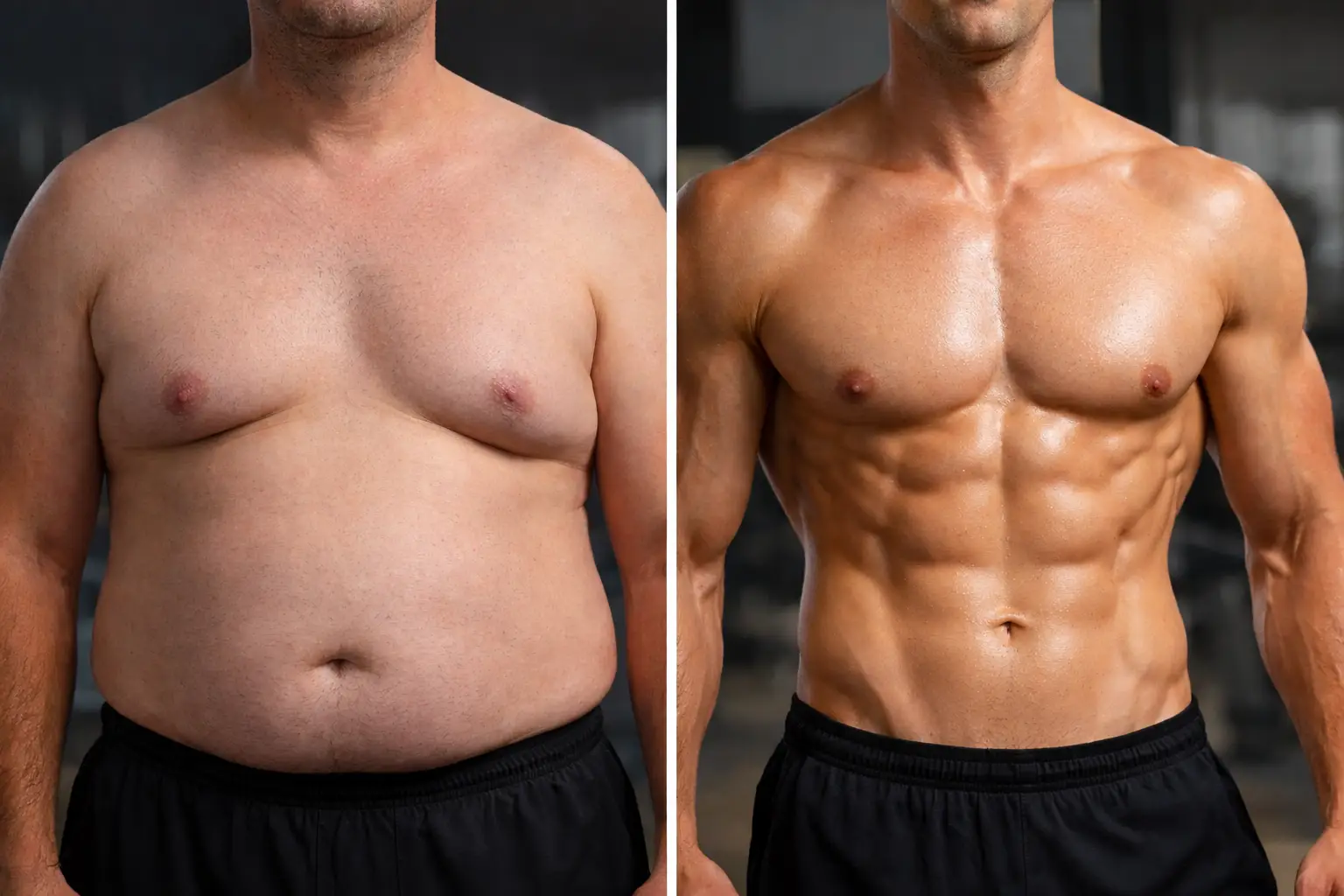
Changes in muscle and fat can be easy to miss when your weight barely moves. Body composition assessments estimate these components separately. Where results include skeletal muscle mass, that estimate can be compared across assessments alongside fat mass.
What Progress Might Look Like
A higher resistance setting belongs in your workout log, but it is not a measurement of muscle growth. You could be handling a harder ride and still have little change in your skeletal muscle mass estimate. Record the resistance and pedaling speed so you can compare that session with later rides.
Your assessment results may tell you something the scale misses. For example, if several readings show less estimated fat mass and stable skeletal muscle mass, an unchanged weight would leave out part of the picture. That does not establish that cycling caused the change, but it gives you more information to review alongside your training.
Fat mass is the more relevant estimate for tracking fat loss, while skeletal muscle mass estimates taken under similar conditions are used to monitor muscle maintenance or growth.
Keep Testing Conditions Consistent
Preparation before testing can affect how a change between bioelectrical impedance analysis (BIA) readings is interpreted. In a 2023 trial, fluid intake affected body composition estimates, prompting the authors to recommend standardized nutrition and hydration before testing. Following the same instructions each time helps make the results more comparable.
How To Combine Biking With Strength Training
Alongside the muscle-strengthening guidance noted above, the CDC recommends 150 minutes of moderate-intensity aerobic activity per week, 75 minutes of vigorous-intensity activity, or an equivalent combination. Five 30-minute moderate rides would meet the aerobic portion of that guideline.
The CDC’s muscle-strengthening guidance covers the legs, hips, back, abdomen, chest, shoulders, and arms. Lifting weights, working with resistance bands, and bodyweight exercises are among the options it lists.
Distance and perceived effort describe riding progress, while body composition results taken under similar conditions describe changes in fat and muscle.
Frequently Asked Questions
What Muscles Does Cycling Work The Most?
Cycling mainly works your quads, glutes, hamstrings, and calves, with the quads and glutes helping drive the pedals downward. How much each muscle contributes can vary with resistance, pedaling speed, riding position, and the individual rider.
What Muscles Does Riding A Bike Work In Your Core?
Biking involves muscles in both the abdomen and back. In a 2023 study of 12 competitive cyclists, activity rose in all core muscles measured as riding intensity increased, with the rectus abdominis showing the greatest activation. The researchers did not measure changes in muscle size.
Does Biking Build Your Glutes?
Biking works the gluteus maximus, but working a muscle during exercise does not necessarily mean it grows. The 2023 training study discussed above measured thigh and lower leg muscles, not the glutes, and dedicated strength exercises are commonly used alongside riding for glute growth.
Is A Stationary Bike Good For Building Leg Muscle?
Some thigh muscles may grow with progressive stationary cycling. A small 2023 study found growth in parts of the quadriceps after 12 weeks, but no significant growth in the lower leg muscles measured.